Showing posts with label representation. Show all posts

Thursday, November 10, 2022

Blogging on Industry: an example

 I set a simple task: pick one Film Guardian article, then 1 post from this blog; blog the key points. I'll demo below how I would do this for the links shared.


DISNEY: BIG 5 FINALLY CHALLENGING BODY NORMATIVITY? SHORT FILM: "REFLECT"

Lets not get carried away - it is a significant moment for the home of the skinny princess, shaper of many young people's expectations of body shape and perception of beauty, to have a plus-sized hero, a heroine even!

BUT: "Reflect" isn't a Disney tentpole ($100m+ but these days commonly $200m+) production - what Anita Elberse refers to as 'blockbusters' (she advised the major entertainment conglomerates to produce fewer releases and focus on maximising the global marketing and distribution of these in her 2014 book, Blockbusters). It is merely a short film. AND its animated - they're still not prepared to push $200m+ on the marketing/distribution spend (which is typically around the same as the production budget) for a live action movie with a plus-size female lead.

The animation, Reflect, tells the story of Bianca, a young ballet dancer who “battles her own reflection, overcoming doubt and fear by channelling her inner strength, grace and power”.

It forms part of Disney’s Short Circuit series of experimental films, released over the Disney+ streaming service last month. (Guardian, Oct 2022)

Since it bought up 20th Century Fox (see Wiki), Disney has accounted for a worryingly large % of the global box office (see Disney bigger than Netflix post), a market share increasingly underpinned by the success of its Disney+ subscription service where this short film series can exclusively be found. In 2019 it hit 51% of the global market! (see Deadline

Disney has faced extensive past criticism for the narrowness of its representations and negative stereotyping, but has more recently shifted its stance, even to the point of facing down powerful conservative critics of its stance on including LGBT+ characters.

Another 2022 Guardian article highlighted the anger of conservatives at Disney's increasing LGBT+ inclusiveness, and its response to this backlash.

So - there's a long way to go, but this is a small step forward. Lets wait for the 1st live action tentpole release of this nature before getting too excited though? 

Sunday, July 31, 2016

AFRICA Wakaliwood joins Nollywood, YouTube distribution

The production values, and recording equipment, are far below what a typical Western student can access - but this trailer alone has nearly 3m hits
Bit of a wider perspective on how the film industry works in a neglected (in terms of media coverage or awareness) market, Africa.

Nigeria's Nollywood has earned a reputation as artistically and commercially significant, now comes Uganda's Wakaliwood...

Consider the incredible kit and resources you can access as you read about Isaac Nabwana, shoestring film producer. Sample paragraphs below. 

See Quartz Africa's full article.

Saturday, July 09, 2016

StudioCanal UK film biz risks Brexit sinking

This is a great overall look at the operations of StudioCanal, a key player for both Warp and Working Title, and also a producer itself now (notably Paddington and a forthcoming sequel)

StudioCanal UK are already seeing costs up by 15% as sterling (the UK currency) has nosedived in value since the referendum. Their CEO, Danny Perkins, explains that the UK will need a specific treaty (as Switzerland has negotiated) to gain continued open access to EU cinema markets - which could take years, if it ever happens. Euro-financing has also been made more difficult to access. If US studios fill that void, they are MUCH less likely to support ideas which reflect British culture instead of taking a more generic, commercial approach.

Consider the practicalities too of StudioCanal personnel trying to visit other Euro branches, or even just pre-production visits and research if UK citizens require visas to do so.

Thursday, February 18, 2016

REPRESENTATION + BOX OFFICE Why Mickybo flopped

Note the lack of official reviews.

**a linked, more recent film to consider alongside this: Warp's '71**

LINKS:
IMDB.
BoxOfficeMojo.
Wiki.
RottenTomatoes.
Trailer; VoD.
Culture NI feature.
Fan-made video (young boy).
Russian fan-made video/trailer?
OST as YouTube playlist.
1st 10 minutes + playlist.

Son of Rambow Wiki; trailer; BoxOfficeMojo;
WT2 IMDB.


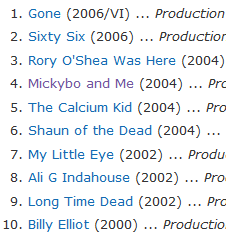
This was one of Working Title's WT2 productions, their shortlived Indie-style subsidiary for low budget films:
IMDB's list for WT2

IMDB figures; BoxOfficeMojo puts it at $465k - but still a UK release only.


BOX OFFICE, AND A POTENTIAL AUDIENCE LOST?
This film came out around the same time as Son of Rambow; both films were about two boys obsessed with a movie (Rambo; the Western Butch Cassidy and the Sundance Kid). The film set in southern England did much better at the box office ... TWENTY TIMES better!!!

Tuesday, February 09, 2016

Bridget Jones's Diary v This is England

TBC!!!
We've been exploring the similarities and differences between these, and I'm going to note some of the points we raised below - I've blogged extensively on both, and I'm not trying to reflect the full range of that in this one post!

To add:
BJ:Edge of Reason The-Number.com report; box office report; with the 2001 original taking $282m and the 2004 sequel $264m, only Les Miserables (2012) keeps the franchise off WT's all-time top spot ($442m) [the-numbers all-time list].

Other films that come close: Bean (1997) $257m, Love Actually (2003) $248m, 4 Weddings (1994) $242m [their most profitable film as a $4.5m budget!], Everest (2015) $204m. Those are the 7 WT films that grossed $200m+ worldwide.

9 more top $100m: Burn After Reading (2008) $168m, Johnny English Reborn (2011) $165m, The Interpreter (2005) $163m, About a Boy (2001) $131m,  Atonement (2007) $130m, Everest (1998 44min IMAX film) $128m, The Theory of Everything (2014) $122m, Billy Elliot (2000) $110m [2nd most profitable as a $5m WT2 production], Paul (2011) $101m.

THE CONTENDERS

Working Title, StudioCanal, $26m budget. £42m UK box office ($61m), $72m US ($281m world)

The money and the lead are American; the marketing in the UK featured Grant and Zellwegger, but everywhere else it was only Zellwegger featured on posters, sleeves etc. (Stereo)typically London/South setting, and comfortably middle-class (and upwards) white characters. A female director ... who wouldn't work again for several years despite the success with this (she didn't direct the sequel). A franchise, an increasingly key part of a successful film company's output and strategy, with considerable merchandise too - and even tie-ins (Does my Butt Look Big In This 2-for-1 London-New York seat?). 

Monday, February 16, 2015

Past exam questions

All the past questions are written in below

The 2014 AS exam clip, plus the Examiner's Report, is here - you can see the exam paper below.

Remember, its a 2 hour exam: 1st 30 mins view Tv Drama clip 4 times in 30mins then 45mins for essay on 4 technical areas (sound, editing, camera work, mise-en-scene) + 1 area of representation (from gender, age, sexuality, ethnicity, social class and status, regional identity, physical (dis)ability); 45mins for British Cinema essay (the section is headed Institutions and Audiences).

There is only one question to answer. It will NOT mention film, as the question is intended for all Media students regardless of which industry option they have studied.
Here's how it appears, followed by a full list of past questions:

Answer the question below, making detailed reference to examples from your case study material to support points made in your answer.
Discuss the issues raised by an institution’s need to target specific audiences within a media industry which you have studied.
You must choose to focus on one of the following media areas. You may make reference to other media in your answer.
•           Film
•           Music
•           [etc – 6 media are listed]

Here's what the key pages of the exam paper look like (from the 2014 exam):
Click to enlarge, or ctrl/CMD-click here.


2008 SAMPLE PAPER: Discuss the issues raised by an institution’s need to target specific audiences within a media industry which you have studied.

JAN 2009: Discuss the ways in which media products are produced and distributed to audiences, within a media area which you have studied. 

TV DRAMA: AGE: Monarch of the Glen.

Sunday, January 25, 2015

UK films in thrall to upper classes? Kingsman eg

In a colourful review, replete with some strong language, the central theme is:

The film gives international audiences what they expect from Britain – a nice bit of posh – while also titillating natives with convincing oik detail. 


The film is summed up thus:
In Kingsman: The Secret Service, out next month, a tasty little herbert called Eggsy from a London sink estate is recruited by the impeccably soigné, lah-di-dah spook Harry Hart, played by Colin Firth. Hart detects that Eggsy has the right stuff, the true Brit if you will, to transcend his oikish upbringing and become One Of Us. Now if Eggsy, played by Taron Egerton, can survive the training course in which he is pitted against a bunch of stuckup, over-entitled Oxbridge ponces (plus the token bit of hottie posh whose snobby froideur melts at our hero’s bit-of-rough charms), then he can become a Kingsman.
Sounds rather like the M.O. of Working Title ... but is primarily a 20CFox produced and distributed film (with TSG and Marv).

WHY do film-makers keep insisting on this narrow, ultra-clichéd stereotypical representation of 'Britain'? Simple really: because it is so familiar, it is easier to market. Furthermore, whilst often used within US-set films as characteristics of a villain, the posh Southern English chap/dame is at the same time an aspirational (cf. the 'uses and gratifications theory', explained in this post; the aspirational point could be applied to the 'personal identity' category) figure for many ... not least many in the US audience who might condemn a class system in the USA but simultaneously perceive the same thing in a 'British' context as glamorous and appealing.

The major brands who have paid $100m+ for product placements in the most recent Bond movies clearly perceive this to be true! (See Telegraph gallery, Guardian analysisetc!)

Tuesday, January 20, 2015

Working Title referenced as byword for bland

Spotted the WT reference in this opinion piece*, which worries that the push for global audiences will see TV sitcom producers squeeze the distinctively British characteristics out of 'our' TV, hoping to make the shows easy to sell to foreign markets, especially America:
Pulling was a classic British sitcom in that it was riven with self-loathing, and its situation – the gap between its characters’ desire to pull and their capacity to do so – inherently fraught and fruitful.In Catastrophe, Horgan plays a woman who gets pregnant after a brief fling with a visiting American, played by the standup Rob Delaney. Already, this feels Working Title-ready: a sit- that more readily begets rom than com. Then there’s the detail.In, say, the similarly plotted Knocked Up there was some tension over whether a groomed high-flier and an unemployed stoner would be able to make it to the delivery room. In Catastrophe they seem ideally suited from the get-go. He’s a successful businessman who wants to move to the UK, marry her and sit through awful suppers with her friends. They are a happy couple expecting a baby. They have hot sex and give each other justifiable compliments. This is not how I want my British sitcoms to be.I don’t want them to be like Friends – soaps in disguise, scripted by a crack squad of gag writers. I don’t want them to be Americanised; to be glossy and hopeful.
I wonder if this will catch on, WT as a byword for 'British' media productions rendered culturally void by the process of Americanising to boost export potential?
[*SOURCE: The push for a global audience could be a catastrophe for British sitcoms by Catherine Shoard, http://gu.com/p/453cc]

Thursday, May 14, 2009

This Is England (Shane Meadows, 2006): Case Study

If the Richard Curtis/Hugh Grant series of WT rom-coms exemplify one prominent trait of contemporary British cinema, the gritty, low-budget social realism of films like this mark out quite a different trend within the UK's film industry. Whilst nothing like as commercially successful as BJD, Love Actually et al, it can certainly be argued that films like this are culturally vital to Britons' sense of self-identity.
PRODUCERS' PROMOTIONAL BROCHURE
This Is England promotional brochure This Is England promotional brochure DB

Potential financiers of this film would have seen this brochure, which seeks to sell the idea before filming can commence.