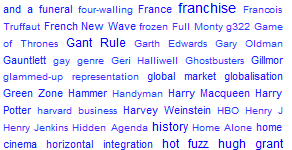
Showing posts with label China. Show all posts

Friday, February 26, 2021

How $100m tentpoles make money!

$100m+ budget movies are known as tentpoles for a simple reason: no company can afford too many consecutive flops at this level.

So why, as Elberse argues they all should, do the big 5 all focus on tentpole or (as Elberse calls them) blockbuster productions?

Remember too that the prints & marketing spend is typically about the same as the production budget which is why, with cinema's cut factored in, box office needs to hit triple the production budget to start making money!!

This excellent stephenfellows feature breaks it down.


So - the true costs of a $100m tentpole actually go MUCH higher.

How on earth do they make money then?!

Well, these days they have a wide range of revenue sources and distribution/exchange outlets.

Friday, August 21, 2020

WORKING TITLE The High Note 2020

8m trailer views just on the Focus Features channel alone by 26.8.20:


VERY BRIEFLY...

  • $20m production; limited cinema release - $19.99 PVOD (NBCU keep higher % than box office)
  • Co-production: WT/Perfect World - a Chinese co
  • Leads aren't A-listers yet but features Ice Cube as antagonist
  • Unfortunate hero's journey? White Dakota Johnson seeks to push out Ice Cube
  • Zeitgeist/generic: riding on success of many recent music biz hits (Yesterday! A Star is Born)
  • Real-world singer (like Yesterday) used on OST; vinyl release
  • Feelgood ending/American dream (Billy Elliot...) - note the prominent Vogue quote: "perfect entertainment"
Scroll to the bottom for some sample paragraphs employing a range of terminology ... which will help with the crossword I've done on this film...

Saturday, March 21, 2020

DISNEY China, convergence and franchising exemplified

UPDATE...
China had 4 of 2019's top 20 WORLDWIDE films. In September 2020 it was easily the world's biggest cinema market with the US covid-hit. Read an excellent analysis here.

As of the end of 2019, China now has 69,787 cinema screens, up 9,708 from 2018, according to the Communist party mouthpiece the People’s Daily, which added that more than 1.7 billion tickets were sold. The propagandistic publication went so far as to deem the current moment a “golden age” for the Chinese film industry’s development, as “the market bubble fades… and Chinese films continue to steadily improve.” (Variety: China’s Box Office Hit New Heights in 2019, as Hollywood’s Share Shrank. Good detail on how the Chinese market is shifting towards homegrown hits)


Mulan shows how far Disney will go, self-censor, to maximise the Chinese market (Guardian).

Disney is so damned big it even owns one of its main TV subscription rivals, Hulu. The mighty mouse movie company now gets 50% of its revenues from its multiple theme parks, but is also as much a TV company as it is a film company - from its subsidiaries like ESPN (sports channel) to zeitgeisty series making baby Yoda a global phenomenon, there's more to Disney than movies.

It's buying spree was seen as crazy by some - but bear in mind that Marvel cost them $4bn ... and the last Avengers movie alone raked in $3bn from the box office, never mind its value in driving $5.99/month subscribers to Disney+.

It's even managed to get back into China, having been banned for years because of pro-Tibet movies it now has a Shanghai Disneyland (but it's 57% owned by the Chinese government!) and since 2016 it has been getting movies distributed there again. Their Mulan remake has changed a lot of aspects to avoid upsetting the Chinese government!

This article ends on an intriguing notion - because their stock market value has dropped by over $80bn since the coronavirus hit (a third of their value) ... could Apple sweep in to buy this giant???


Statista.com breakdown of China's surging global share

Friday, June 16, 2017

CHINA How Hollywood targets Chinese cinema

A handy overview of how Hollywood is tweaking its output to appeal to the Chinese market - an ironic mirroring of how British films (at least those with higher budgets affording a US star or two) have long made huge compromises to appeal to the US market.

This is a trend you need to grasp if you are going to speak/write with any autohority on the film industry.


...

Rock vehicle Skyscraper set in China (but white westerners lead the action AND actually shot in Vancouver!): Skyscraper review – The Rock towers over an inferno of cliches

https://www.theguardian.com/film/2018/jul/10/skyscraper-review-the-rock-towers-over-an-inferno-of-cliches?CMP=Share_AndroidApp_Copy_to_clipboard

Thursday, November 10, 2016

BOX OFFICE: Gant Rule in 2016

IN THIS POST:
A definition of 'the Gant Rule'; testing it out with the summer 2016 UK/US box office; why is this so profoundly significant for understanding the British cinema market; how satirical cartoon Curtisland illustrates this; why does it not always work (including Bridget Jones example).

I was surprised just now to find that 'the Gant Rule' doesn't bring up many relevant hits ... until the phrase 'box office' is added to the search.

Lets have a fresh look at this...

A SHORT DEFINITION OF 'THE GANT RULE'*
Box office analyst Charles Gant (who has a weekly Guardian column, but whose writing appears in many other publications worldwide) has long argued that a typical transatlantic hit (a success in both the UK and US markets) will make ten times as much in the US ($ figures) as in the UK (unadjusted £ figures).

In short, for a UK/US hit, UK £box office x10 roughly = US $box office
*it is highly advisable to put such terms in '' to help denote them as technical terms; the media world is so vast and complex, no single examiner will be familiar with every conceivable term

Is he right? Usually, yes!

READ MORE:
I have blogged on this a few times...
Use the Gant Rule tag to find previous posts - or simply make your own comparisons with films' UK/US box office!


TESTING THE GANT RULE: SUMMER 2016 UK v US BOX OFFICE
 Captain America: Civil War + The Secret Life of Pets examples
Using figures from his ScreenDaily column, Gant looked at the 2016 summer box office on both sides of the Atlantic. Jump straight to the number one hit and you'll see a prime example of the Gant Rule in effect: Captain America: Civil War took £37m in the UK and $407m in the US. That's precisely x11 the UK figure - pretty accurate forecasting there!

Sunday, September 04, 2016

AUDIENCE ANALYSIS Star Trek fails to live long and prosper?

This post focuses on the LA Times' box office coverage, which provides very specific audience breakdown and analysis.

The headline above is from 
Gant's column on the UK box office, matching a more common downbeat view on the film's fortunes and prospects (its still on wide release), noting:
Star Trek Beyond may have suffered from director JJ Abrams’ exit into rival franchise Star Wars (he remains as producer). Or fans might have been more excited by Benedict Cumberbatch as the main villain last time around, with Beyond baddie Idris Elba less proven at the box office. And Paramount may have struggled to persuade broader audiences to see a third Star Trek film.
Critics and audiences have been highly positive, but the film has failed to crossover to a wide US or UK audience (RT)

BoxOfficeMojo provide a comparison of all 13 movies in the franchise; the current release needs a major boost from China and elsewhere to ensure the franchise will continue to ... live long and prosper


The various box office columns (global, US, UK) in the Guardian make for great reading and will teach you a lot about how the industry works, and provide very specific examples that might help you in exam and/or coursework efforts. Variety and many others also provide in-depth, highly informed analysis and commentary - you can keep an eye on these by adding RSS feeds to your own blogs.

This example is from the LA Times, which you'd expect to be highly versed in industry practice as Hollywood is in its turf. The fragment I picked out below comments on:

Tuesday, August 16, 2016

CHINA bans Apple, Disney movie channels

While growth in the US is slowing, its international expansion is doing well, and though it may not have many subscribers in Syria or North Korea, it claims to be in all but one market globally. But that market is the world’s largest, China, where it has faced the same political barriers as other western media and technology companies.

“The Chinese government just closed down the Disney movie service. And they closed down Apple’s movie service. Those are two pretty sophisticated, relative to China, companies. It looks like the government just doesn’t want the foreign content distribution. Maybe someday in the future there’ll be an opportunity for us in China, it’s possible. We are continuing to work on it.”

Wednesday, July 27, 2016

Gant Rule, British exceptions and the China factor

UK box office of $60m rivalled the US ('domestic') take

Cinema is at once BOTH a highly globalised industry utterly dominated by the big six US conglomerates AND a highly localised industry in which local stars, settings, even IP/cultural reference points, sell.

The Gant Rule is a useful means of explaining the US dominance, even as this is swiftly undermined by the surging scale and value of the Chinese market, pushing the typical US box office share of a typical global hit to well below the traditional 50%+ (closer now to 40% and falling). This has seen Hollywood squeeze in Chinese stars and settings, shoot alternative endings and extra scenes for different markets, buy up or partner with Chinese firms (with the complication of strict Chinese laws on exporting money), and generally be more sensitive about portraying Chinese as villains or simply the traditional crass stereotype of inscrutable, unemotional, indistinguishable masses (not that this has entirely disappeared).
Headline from  The Wrap
Universal spent millions altering the plot of World War Z (reshoots) so that the epidemic didn't start in China in a doomed attempt to get into the Chinese market. Censors there frown upon horror ('The country has strict laws outlawing any movies that deal with magic, horror or superstition.'). China limits the number of non-Chinese productions allowed in cinemas to just 34 a year - though this may rise in 2017 following negotiations with the WTO (World Trade Organisation). It is not making it easy for Hollywood to extend its global dominance:
...in other cases studios don’t alter their movies until post-production. Chinese censors cut large chunks out of several movies released last year, including 40 minutes from “Cloud Atlas” and 12 minutes from “Men in Black 3,” excising all scenes in Chinatown.
They also cut parts of the latest James Bond film, “Skyfall,” including a scene that featured the assassination of a nameless Chinese security guard.
Marvel had initially planned “Iron Man 3” as a Chinese co-production, a tactic that has been taken with films like “Looper” and “The Karate Kid,” in part because co-productions are not subject to China’s quota for imported films. Chinese censors must still approve them. [The Wrap]
Just 20 years ago China banned all foreign cinema:
China only opened its market to the Hollywood studios in 1994, when its own film industry had reached its nadir. “It wasn’t out of admiration for Hollywood but to save the Chinese film industry,” Rosen said. “People weren’t going to the movies.”
At the time, China only permitted 10 foreign movies to screen, then increased it to 20 before the current total of 34. Those additional 14 slots are all reserved for IMAX or 3D films. [The Wrap]

There is no questioning the ongoing utter dominance of the UK market by Hollywood - for figures read the annual BFI reports. BUT ... localised content still often retains an edge.
The US star helped market the film globally, but the British setting did not help US box office: boxofficemojo.


Localised here is a very broad concept - as is the legal definition of 'British production' for tax purposes:
The UK box office has consistently punched above its weight with family films adapted from British-authored material, fromCharlie and the Chocolate Factory (£37.8m) and Alice in Wonderland (£42.5m) toThe Chronicles of Narnia: The Lion, The Witch and the Wardrobe (£44.4m) and, of course, Paddington (£38m).
These are mainly Hollywood productions, but with enough of a lingering element of Britishness to give them a home market boost, and so undermine the Gant rule. The Bridget Jones franchise is a more direct example, although it too is ultimately Hollywood fare (Brit producer WT being an NBC-U subsidiary, Polygram at the time of the original).

Gant's latest box office column highlights The BFG as the latest to benefit from this element of Britishness.

He also noted the latest example of event cinema, an annual classical concert now programmed in an incredible 534 screens, plus a stylized limited re-release earning more than the original run:
Also flying the flag for event cinema was Secret Cinema’s presentation of Dirty Dancing. ...  The run of just six dates delivered a final box office of £1.90m. That’s more than the combined runs of the original 1987 release (£1.62m) and the 20th-anniversary rerelease in 2007 (£224,000).
The BFG towers over UK box office while Star Trek Beyond fails to prosper.

A little bit more on the rising influence of the Chinese market, from an article which looks at directors outraged by remakes of their movies, in this case Red Dawn. The original 1980s flick saw Russians invade a US town, the recent remake swapped Chinese forces for this...until it dawned on the money men that they'd lose out on the Chinese market...so this was belatedly switched to North Korean forces:

Milius was partially vindicated when MGMchanged the invading aggressors to North Koreans for the final cut, though that move was made to appease the lucrative Chinese market more than to cheer up the original film’s director.

How dare you remake my classic! When directors attack

http://www.theguardian.com/film/filmblog/2016/sep/16/how-dare-you-remake-my-classic-when-directors-attack?CMP=Share_AndroidApp_Copy_to_clipboard

Tuesday, July 19, 2016

Global ticket prices compared

The average ticket now costs $8.73, up from $8.58 during the first quarter and a 1.4% year-on-year rise. The numbers represent an average across all venues, titles and times; this tends to rise as the family and blockbuster season begins.The year actually began down on the numbers for 2015, which hit $8.70 in the fourth quarter, as Star Wars: The Force Awakens screened.However, prices in North America continue to compare favourably with those in the UK, where the average price last year was £7.17 ($9.47) – a rise of 48.25% over the decade.In China, whose box office revenue is due to overtake that of the US later this year, the average price is $6.50. The cheapest tickets are to be found in India. Average prices for single-screen cinemas in 2013 were around $0.93, rising to around $3.95 for multiplex screenings.

US cinema ticket prices reach record high.

Friday, April 15, 2016

CONVERGENCE US cinema chain oks texting. sadface

I gather that after less than favourable feedback this horrible idea was binned, but multi-screen viewing is certainly a serious issue for film. And I found myself watching the latest Bourne and being very irritated at a pair to my left lighting the room with their phablets - even more than the ridiculous overuse of non-diegetic music to impress the kinetic tension on the producer-imagined dumb audience (in Aug 2016, a few months after picking up on this)


US cinema chain might introduce 'texting-friendly' screens.

Also ...
The Blue Room is being released in the UK by MUBI, first theatrically, then online. How do you feel about cinema becoming an online phenomenon?People keep saying that cinema’s about to die, but it has a way of transforming itself all the time. I never feel like saying: “It was better before.” OK, watching a film in a cinema is something different, but now people can use new tools, watch in different ways – they’re even able to watch three screens at once. That’s changing the grammar of cinema, it becomes like a mash-up or something. You have to take an interest – you have to use it all. [Mathieu Amalric: ‘Cinema has a way of transforming itself’]

Thursday, March 24, 2016

Biggest cinema markets ranked by box office. UK in top 5

These will vary over time, but the UK and France are Europe's biggest markets, with Japan and China key Asian markets. China is expected to eventually exceed the US box office (perhaps towards the end of 2017?), but India's massive population is less likely to follow suit with ticket prices so much lower in the countryside.

The UK is dwarfed by the US and China, but it, France and Japan are closely matched and are ranked differently depending on the survey/year but is the 3rd, 4th or 5th biggest cinema market in the world, a definite top 5 market. Note how low its share from nationally produced films is - US films account for 4 times the box office of UK-produced films. No figure is given for the US but this would be in the high 90%+ range.

Table from Wiki. Note that China's figures are more recent than the rest, significant as they are growing every year.

Tuesday, December 08, 2015

CHINA's monstrous box office mythical, actually

This post is a simulacrum of itself - Google, why can't you sort out the damned Android app??? TWICE I've written (tapped ) this and twice its disappeared by switching apps or trying to navigate in the blogger app*. Not good.

Anyway... I've mentioned before the issues around the fantastical claims of China's explosive box office growth. Taking their cue from the Hollywood hegemons, who make 'biggest ever' standard marketing fare, we've seen the same approach to box office figures as to the Chinese stock market: only good, upbeat news is allowed. Make that was.

A recent US-China trade deal means that China now has an increased legal duty to ensure box office figures are accurate, and clamp down on piracy. The Chinese government finally permitted the huge 'correction' (econospeak for massive fall) in the value of the Chinese stock market recently, and with the state media reporting on suspicions that the home-grown CGI-fest Monster was exaggerating the box office returns, we're seeing the start of a similar process.

India will undoubtedly become a hype story soon enough, with equal issues over its figures, given how 'cinema' runs in the still huge rural market; listen to Chuck D and don't believe the hyp when that becomes the next meme.

The Western markets have inspired this behaviour - cinema crowds do operate on a herd/heard (word-of-mouth ...) basis, and we flock to a hit. As a recent, typically insightful Guardian box office column pointed out, the studios have been engaged in unattributed flame wars seeking to brand each other's tentpole releases as flops through social media, hoping to convince people to avoid them.

China takes box office manipulation to the twilight zone - as this article reports, the figures for Monster were inflated not just by benefitting from the period when US films are blocked each year, but also 40m 'public welfare' tickets given out to families. This often results in empty cinemas screening in the early hours, a phantom operation indeed (just how many horror intertextualities can I squeeze in from dusk 'til dawn...).

I guess the moral of the story is, don't get too wrapped up in box office this yuletide...

*The blogger app is handy but its way too easy to lose something you've worked on - don't try to switch windows to ... ironically, given the ownership ... Google something for example! A longer, wittier version of this post had appeared on the wrong blog, was shown as an earlier link-only post when I tried to navigate back to the right blog to re-post it ... and deleted entirely along the way. VERY annoying. Brings to mind Battlestar Galactica's haunting version of All Along the Watchtower: "all of this has happened before and all of this will happen again" [and thats the second time I've typed/tapped that ... this time on a Macbook now on 4% battery!]

Thursday, March 05, 2015

China beats US monthly take. Birdman 125% Oscar bounce

The box office columns continue to be a rich source of context and analysis. This column in global box office highlights two industry trends - the Oscar bounce (Birdman grew by a sensational 125%, with the distributor TRIPLING the screen count), and the inexorable rise of the Chinese film market. February 2015 saw the monthly Chinese box office beat America's for the first time, with the annual take widely predicted to exceed America's $11bn by 2018, with huge implications for production (casting, settings, varied cuts as with World War Z for different markets...):
China’s hesui pian – its New Year films – have become hotly contested fixtures, as shown by the news that February was the first ever full month in which the country’s box office exceeded the US’s: $650m to $640m. This happened largely because China’s key release window coincides with a month of no great consequence in the American box-office calendar (a big July, containing Independence Day, can bring in $1.3-1.4bn). But February’s figures are still a minor watershed in the lapping of the box-office tides, a sudden toe-wetting promising the big wave to come. And that is where Chinese annual takings finally wash over the $11bn mark the US has been hovering around for much of the past half-decade; even taking the most conservative Chinese annual growth rate (30%) of the past few years, that is due to happen in 2018.

Tuesday, November 11, 2014

The Rom-Com Audience

I've cross-posted this on the rom-com and AS Coursework blogs, so won't post again here, but there is a lot of info and analysis very pertinent to British Cinema in there, with Warp and Working Title prominent in the analysis and examples used.

Read it here.

Tuesday, May 06, 2014

UK Cinema 2013 review - BFI key facts

You can find a wide range of BFI reports here (see screenshot below).

I've been reading through their 2013 Statistical Yearbook report - as its a cool 252 pages long, the following are just a few of the many points you can pick up from a skim or a more leisurely read yourself.

2013 BFI Yearbook - Selected Points
Note: Definition of ‘UK film’
For the purposes of this chapter, a UK film is one which is certified as such by the UK Secretary of
State for Culture, Media and Sport under Schedule 1 of the Films Act 1985, via the Cultural Test, under one of the UK’s bilateral co-production agreements or the European Convention on Cinematographic Co-production, or a film which has not applied for certification but which is obviously British on the basis of its content, producers, finance and talent. Most UK films in the analysis (including the major studio-backed films) fall into the first group – films officially certified as British.
[p.76; see longer quote at the end]
Only the US and Japan have a larger 'filmed entertainment' market than the UK (valued at £4bn).

Monday, September 23, 2013

China set to challenge Big 6 hegemony?

Cinema's global narrative has been well established for many decades: notwithstanding the efforts of some national cinemas to protect their local industry/culture, typically through some mix of state funding or quotas (setting a limit on US imports, or a minimum on the proportion of locally-produced movies cinemas must screen), a small handful of US conglomerates has utterly dominated film industries in most nations on earth. This extends beyond production to distribution and exhibition too, though its the production dominance that is most immediately noticeable.

Sunday, April 14, 2013

GLOBAL BOX OFFICE: continued US dominance?

Figures for the following are taken from Phil Hoad's article, Hollywood's hold over global office - 63% and falling (2.4.13), itself based on this MPAA annual report. Figures are for the full year 2012.
Worldwide box office: $34.7bn
US $10.8bn
non-US global box office = 69% of total (ie, US = a third of all global box office)
Asia-Pacific box office jumped 15% to $10.4bn, with China overtaking Japan as world's 2nd-biggest market (Hoad argues that it won't maintain the 36% rise every year + so rejects the argument that it will overtake the US by 2020)
'One thing beyond dispute is that Asia-Pacific is poised to overtake the EMEA region (Europe, Middle East and Africa), which shrank slightly last year to $10.7bn, very soon.'
'The third region used by the MPAA for global box-office purposes – Latin America – logged a small rise, from $2.6bn to $2.8bn.'

Crucially, note that these figures are for tickets in those regions - US-produced films continue to dominate worldwide, hoovering up nearly 2-thirds of global box office (60-70%) - see below for more details. That actually means a steady fall since Avatar set the recent high in 2010, although 4 of the big 6 made over $2bn from non-US box office in 2012!

A lot of figures, the point is that these provide useful, specific evidence of the context of US dominance in which UK companies must operate.
The MPAA report is still, sadly, low on detail on overseas activity, despite abroad being where Hollywood's compass points these days. It certainly doesn't broach the touchy question – loaded with the old cultural-imperialism chestnut – of exactly what level of dominance Hollywood enjoys worldwide. So, using Metacritic's figures for respective studios' takings in 2012, I've done some calculations of my own. If worldwide box office was $34.7bn, and the six majors' combined box office was $21.773bn, that means American cinema enjoyed a minimum 62.7% share of the globe (this doesn't take into account films by smaller producers, including Lions Gate, which is virtually a proper studio now). Applying the same methods for the previous three years, the percentage comes out as: 2009, 63.9%; 2010, 67.4%; 2011, 66.9%; 2012, 62.7%.
Does this four-year snapshot mean anything? It certainly reinforces that the US remains the 900lb gorilla of world cinema – gripping what, if complete stats were available, would probably be closer to 70+% of all box-office receipts. But Kim Jong-un and devotees of cultural diversity can also comfort themselves with the fact that this share seems to be dropping – from a 2010 peak when Avatar skewed the spread – at a time when overseas markets are expanding rapidly and the studios are straining to devise "global content". And the drop was a fairly dramatic one in 2012, despite a fair performance across the board from the big six (four made it over the $2bn mark in international markets), and a year that contained a No 3 entry for Disney, Avengers Assemble, on the all-time list. So this shows why the MPAA flapped so hard about the Chinese government's anti-competitive practices – forcing US blockbusters to run off against each other on the same weekend, and blackout periods for foreign releases. As new cinema markets become larger and more sophisticated Hollywood will have to fight harder to retain the status quo.

Saturday, January 05, 2013

Cinema in 2013 will be...

Lengthy feature, broken down into shorter themed sections, from the Gdn Film Blog (if you don't already follow it you should!) here on what 2013 will bring for the cinema industry: read the article here or (partially reproduced) below.  

Care to add your own predictions as a comment? Will the 3D boom continue or tail off? Will home cinema 3D once again undermine cinema? Will streaming overtake DVD sales as a source of revenue? Will the window between exclusive theatrical exhibition and DVD/TV/streaming continue to shrink? Will the US audience continue to shrink as a % of Hollywood revenues for its own films - and if so, will this lead to greater multi-ethnicity in the casting of leads, or a shift away from depicting American power (surely a key tool of US political hegemony)? Will digitisation open up greater opportunities for Indie producers ... or will the tentpole strategy (closely tied to franchising sequels, prequels and remakes/reimaginings) continue to maintain big 6 global dominance? Will YOU go to see any film in the cinema in 2013 - or turn increasingly to viewing film on tablets, laptops etc?

Brits in Spandex and girl power: movie trends that will keep us talking in 2013

Last year, Hollywood was flush with international cash and films starring Matthew McConaughey. What will this year hold?
Angelina Jolie as Maleficent
Angelina Jolie as Maleficent represents the latest trend for Actresses of a Certain Age Who Aren't Really That Old: playing the bitch. Photograph: Disney

Time travel was popular. Prequels were hot. As were guns-for-hire, vampires and movies set on boats. Which of the year's cinematic trends, people, cultural avatars and epiphenomenon are most likely to set the agenda for 2013?

Jennifer Lawrence

In X-Men First-Class, Jennifer Lawrence wore the lightly stunned look of someone suffering from an acute case of Newcomer Bends. But then she narrowed her eyes, strung her bow and fired The Hunger Games towards $686m: Lawrence's imperturbability was revealed as the genuine article. The scene in Silver Linings Playbook where she walks into de Niro's lair and has him eating out of her hand in under five minutes may just win her an Oscar at the tender age of 22. If that weren't reason enough for New York magazine to put her at the top her their "Celebrity Brunch League" – the lost of famous people they'd most like to have pancakes with – the editors listed a few more:
She complains about her fussy premiere clothes; she crashes into cars while looking for Honey Boo Boo. There was that time that her entire family went to Sleep No More in search of orgies … Jennifer Lawrence cannot be contained by your Movie Star Rules of Decorum; Jennifer Lawrence has too much to share.
We concur. She's like Liz Taylor without the alimony.

Girls

Jennifer Lawrence wasn't the only ballsy princess of 2012. We also had the flame-haired, cinch-waisted Princess Merida in Pixar's Brave, the studio's first female protagonist; plus Kristin Stewart riding, fighting, and shooting her way through Snow White and the Huntsman, not to mention her swan song for beloved Bella, now a momma grizzly protecting her vampire cub in the last Twilight movie. They all added up to "an interesting new breed of warrior princesses," said the New York Times' AO Scott, "whose ascendance reflects the convergence of commercial calculations and cultural longings."
Much of the credit must go to Lionsgate, who released both Breaking Dawn Part 2 and The Hunger Games, thus proving conclusively that young female actresses can 'open' and power a movie move way past the $100 million mark. "Girls actually need superheroes much more than boys," said Gloria Steinem, approvingly. Boys aren't the only ones to play Han Solo.
brave film still by pixar Princess Merida – and her bow and arrow – were big hits in 2012. Photograph: Pixar