Showing posts with label franchise. Show all posts

Monday, May 13, 2019

Bridget Jones's Baby boom? Smart marketing, modernised values

DIRECTOR: Sharon Maguire
BUDGET: $35m
BOX OFFICE: UK $60m, US $24m, World $212m
PRODUCTION COMPANY CREDITS: Miramax*, StudioCanalUniversal PicturesWorking Title Films *presumably they retain rights as original film co-producer with WT
DISTRIBUTION: Universal, UIP 62 countries 'Universal is releasing in most territories with Studiocanal handling France, Germany and Austria' [Deadline]
AGE RATINGS: BBFC 15, MPAA R, Lux EA.


Much more to come on one of the most significant Working Title productions for years. They have multiple highly successful franchises (Nanny McPhee, Bean, Johnny English...) but none are as iconic and central to their identity as BJD, the franchise based on Helen Fielding's hit novel.

LINKS:
Wiki.
BoxOfficeMojo.
IMDB.
The-Numbers.
Working Title page.
Daily Mail. #1 in 24 countries; biggest UK September opening ever


AGE RATINGS
Quite an extraordinary variation on this one: BBFC 15 and MPAA (US) R, but U in Luxembourg!


PRODUCTION HISTORY
I've blogged on this for a few years now (here; here on novel + musical; here in a wider post on WT franchising): BJD3 was announced in July 2009! It was then formally greenlit by Universal + WT in October 2011 ... but would take another 4 years for shooting to commence, with Hugh Grant dropping out and a change of director (Paul Zeig was originally attached, but with the film seeming dead in the water Sharon Maguire wasn't attached until negotiations with the principal cast resumed again in June 2015). [details from Wiki]

DIRECTOR
Sharon Maguire was overlooked for the first sequel...
Sharon Maguire, who directed the original Bridget Jones’s Diary in 2001, returned to direct the feature film from a script she co-wrote with David Nicholls (One Day) [source]

FRANCHISE HISTORY
BoxOfficeMojo BJD franchise page.

Monday, September 24, 2018

FRANCHISE FATIGUE as Han Solo makes loss

The empire strikes whack
The franchise model remains king - just look at the top 10 box office on a typical week, or the annual top 10s, and you'll see this domination (existing audience + brand recognition makes them easier to market, and for CGI epics costs can be spread over multiple movies - especially when planned out like the Lord of the Rings trilogy, Avatar sequels or Star Wars movies).

Great new alliterative term to be aware of though - franchise fatigue.
The legendary, nostalgia-fuelled status of the Star Wars franchise is clearly sinking under the weight of annual releases, with the poorly received Han Solo spin-off not quite a franchise killer but the 1st in the series to make a loss!

Just like the star system (Richard Dyer) that Star Wars itself is undermining, nothing is set in stone in the film industry - which is why we talk of conventions not rules!

See 'Too much, too fast': Disney to scale back production of Star Wars movies (Film Guardian - which you can read regularly via the free Guardian app; you will learn a lot more than we can cover in lessons by doing so!)

Tuesday, August 08, 2017

STREAMING Disney quit Netflix for own service. Fragmentation?

Disney now offering streaming TV.

Apple will have to join this suddenly crowded market, with Netflix, Hulu, Amazon and more facing increasing competition.

If more of the big six follow suit, surely that will actually undermine the paid-for streaming industry and encourage a resurgence in piracy?
Not in Lux. yet, but a fullscale streaming option is being rolled out.

Thursday, February 16, 2017

CONVERGENCE Love Actually mini-sequel for TV

What joy - a sequel to the wonderful Love Actually, the profound Richard Curtis classic that puts would-be auteurs like Welles, Hitchcock, Scorsese et al to shame.


Tragically, there will be only ten minutes of this cinematic feast, delivered through TV, as part of the Comic Relief telethon that Curtis helped create. One can only hope for a fourth Bridget Jones movie to ease the pain.

Thanks to Richard for alerting me to this televisual splendour, a nice example of convergence, with the TV/film divide fading - About a Boy being another Working Title example.

LA itself has become a meme since its release; as this article notes, comparisons have been made between the Grant character and Canadian PM Trudeau this week.
A notoriously polarising film, Love Actually’s cultural currency has grown in the 14 years since it was released. The film has been repeatedly unpicked, spoofed and deconstructed; four foreign language films – in Japanese, Hindi, Polish and Dutch – have also been inspired by the movie.
The showdown between Hugh Grant’s upstanding UK prime minister and the boorish, lecherous US president – reportedly based on a Bill Clinton/George W Bush hybrid – has been a touchstone of political discourse ever since. Even this week, Canadian premier Justin Trudeau found himself compared to Grant, following his meeting with US President Donald Trump. 
...


Tuesday, October 04, 2016

WT Billion Dollar Baby Brit Record

Catherine Shoard reports the landmark figure for the British production co

Well hello, hooray! For their competition its welcome to my nightmare, but school's out for the unrivalled masters of the British cinema market...the first British billion dollar babies of the UK (though Rep. of Ireland figures are often combined) cinema audience.

If you're bewildered by the intertextual puns in the above, it may be that you're not old enough to remember Alice Cooper in his prime (the artist in the video below) - Working Title don't go back nearly 50 years in the biz like Cooper, but they do go back 31 years at the time of writing (2016), so their bold social realist (with a comic edge) debut feature My Beautiful Laundrette (they're associated with 1984's The Man Who Shot Christmas too).
THEORY TIP: Stuart Hall argued that semiotics, and much early media theory, had one major flaw: assuming that meaning was completely tied to the producers of a text and their intentions (what they attempted to encode). He argued that meaning is also generated by the audience, and that the meaning they take will be influenced by their age, gender, nationality, cultural tastes, education level etc. Adult readers may pick up on my Alice Cooper intertextual puns, but younger readers may not - though they may generate their own independent meaning too.
If you followed my meaning, thats a preferred reading (the textual author would prefer that); if you follow some but not a substantial part, a contested or negotiated reading; if you reject or interpret in a very different way, thats an oppositional reading.


Today's juggernaut company, with its latest ultra-commercial hit Bridget Jones's Baby yet another franchise release featuring major US stars to boost its international appeal, is barely recognisable from the radical young company that produced a gay, inter-racial romance tale at the height of 1980s Thatcherite homophobia and race riots in Britain, following it up with an edgy wartime drama making a star of its young (unknown, just like the MBL leads) female lead and her catchphrase, up yer bum!

Sunday, September 04, 2016

AUDIENCE ANALYSIS Star Trek fails to live long and prosper?

This post focuses on the LA Times' box office coverage, which provides very specific audience breakdown and analysis.

The headline above is from 
Gant's column on the UK box office, matching a more common downbeat view on the film's fortunes and prospects (its still on wide release), noting:
Star Trek Beyond may have suffered from director JJ Abrams’ exit into rival franchise Star Wars (he remains as producer). Or fans might have been more excited by Benedict Cumberbatch as the main villain last time around, with Beyond baddie Idris Elba less proven at the box office. And Paramount may have struggled to persuade broader audiences to see a third Star Trek film.
Critics and audiences have been highly positive, but the film has failed to crossover to a wide US or UK audience (RT)

BoxOfficeMojo provide a comparison of all 13 movies in the franchise; the current release needs a major boost from China and elsewhere to ensure the franchise will continue to ... live long and prosper


The various box office columns (global, US, UK) in the Guardian make for great reading and will teach you a lot about how the industry works, and provide very specific examples that might help you in exam and/or coursework efforts. Variety and many others also provide in-depth, highly informed analysis and commentary - you can keep an eye on these by adding RSS feeds to your own blogs.

This example is from the LA Times, which you'd expect to be highly versed in industry practice as Hollywood is in its turf. The fragment I picked out below comments on:

Friday, August 26, 2016

Disney bank on franchise not A-List stars selling

Dreddful...star power meant unmasking
Sly to exploit his appeal, rather obviously
ruining the concept of the masked Dredd
I've picked up on this theme a few times, and there is strong evidence to argue the point either way, but there clearly is some doubt emerging over the continuing veracity and vigour of the star system; movie marketing being centred on attaching and selling star names.

The now well-established dominance of the franchise system appears to offer an alternative - though its only Disney currently that seems to be banking on this, its tentpole productions shaving many $10s of millions from CGI-heavy budgets by casting young unknowns in key roles - AND tying them into multi-film contracts that will keep them on relatively low salaries, avoiding awkward renegotiations where actors have a strong hand. Look at the budgets for the first two Scream movies, or BJDiary, for examples of how actors can up their demands to stay in a franchise.

The Disney examples (Star Wars: Force Awakens and much of the MarvelCU, excepting Robert Downey Jr) shouldn't, i think, be seen as typical enough to dismiss the rule #1 of the film business, and Disney currently are an exception amongst the Big Six in taking this approach.

Some franchises/IP have sufficient pre-existing audiences to cope without stars. Harry Potter and the Hunger Games are good examples, so too Twilight (as horrible as those movies are, at least to non-teen, non-girl viewers like myself!).
Shocker: critics and audience hate this movie.

Hollywood showed repeatedly before The Dark Knight kick-started the current MCU hegemony that shoving a big name into an iconic costume is often box office poison: Stallone's abysmal Judge Dredd is the classic example; whether his star brand or performance, or the script, were to blame, fans hated it and a general audience couldn't suspend belief for 90 minutes to really get into Rockie/Rambo as the meanest (robo)cop of them all.

Monday, August 01, 2016

NBC-Universal uses horizontal integration to keep Damon franchise airborne


Okay, so this might not be part of the OFFICIAL marketing blitz from NBC-U - but such trivial but viral UGC as this vine is worth many millions in advertising spend when considered as a whole, able to penetrate beyond core audiences targeted by the distributors. Here's where I found it:
An unofficial JB Facebook page with 48k likes.

The Vine was featured by a UK newspaper:


My main point here, however, is a good example of how the mega-conglomerates can flex their muscles to mutually benefit different wings: NBC-U both creating and benefitting from pre-release hype of the new Bourne movie by playing the Damon-starring previous films across EIGHT of its NBC-U channels. Research indicated that existing franchise fans were the key audience for the movie, so NBC-U sought to reinforce familiarity with the long-running franchise:

Tuesday, March 15, 2016

ROM-COM no more love for the classic hybrid?


I've read a variety of articles over the past decade announcing the death of the rom-com after some genre flick flopped (often starring Jennifer Aniston!).

Here's another ... which goes a step further in pronouncing a range of genres as dead and box office buried, but also argues that TV is now the true home of the rom-com, an intriguing point in this era of digitisation and convergence:

Friday, February 12, 2016

UNIVERSAL tentpole franchise kings hiking ahead

ScreenDaily reports on the huge turnaround, after a poor 2014
IN THIS POST: Analysis of how Universal's shifting strategy impacts on WT; an outline of what this strategy is, with key figures; details of how the new horror universe was proposed in 2014, and how its taking shape in 2016; the Battlestar Galactica bid to take on Star Wars.

Working Title's conglomerate parent, NBC-Universal, clearly knew what it was doing in downgrading its subsidiary's relationship to 'first look' status*; NBC-U would have first refusal over any new WT production, but had no obligation to pick it up for distribution or to fund production proposals. WT have to find their own financing now, even if that still often means pre-signing distribution deals with StudioCanal or UIP, all part of the NBC-U (and Comcast) conglomerate. Gone are the days of massive block funding for WT.
*See this post for details on the new deal (and a definition of first look), signed in 2012 and due to run out in 2015; no news yet of any changes

This shift in approach, which may seem surprising given how successful WT have been, reflects a hardening of Universal's commitment to the tentpole strategy, and the franchising that largely underpins this. Anita Elberse, who uses the term 'blockbuster' in her book, would approve: she argues that this is the only viable approach for any major player in any entertainment industry (she also considers football and music among other industries - a very interesting, digestible read, I recommend it).

Tuesday, May 05, 2015

DIGITISATION, GLOBALISATION, CONVERGENCE Superhero hegemony in brief

Another critic (Jason Wilson) rather irked at the hegemony of superhero tentpoles. If you use the superhero tag in particular you'll find several linked articles analysing the rise of these films and this me-too strategy.

A quick summary follows of key points you can utilise to show your understanding of how (British and global) cinema functions ...

Thursday, April 16, 2015

CONVERGENCE All the world's a Marvellous stage/silver screen

See Marvel section below for analysis; image source.
Age Of Ultron marks Whedon’s swan song in the Avengers director chair but it’s hardly the end of the saga. The two-part Infinity War story has been set in stone for 2018 and 2019, along with eight other Marvel titles. DC, looking to get its comic-book universe up and running, has also announced a hefty release schedule. In tandem with a fresh batch of X-Men sequels, Spider-man spin-offs and Fantastic Four reboots, that’s at least 25 new superhero movies over the next five years.  - Bernstein, 2015See later sections below for analysis of the Marvel universe, UGC, web 2.0 and extended narratives...

I'll add to this shortly [done!]; having blogged on convergence (TV-film) this morning, this caught my eye, and made me think of theatrical adaptations of Bridget Jones, Billy Elliot and such. This can go the other way - West Side Story being an early example, Les Miserables  a more recent (Working Title) example. WT have a long track record of exploiting IP (intellectual property), especially novels, for adaptation (Atonement, BJD...).
Do you believe in fairies? Does Harvey Weinstein?
The famously fractious producer has spent millions of dollars and run through a couple of casts and creative teams in a diehard attempt to transform the 2004 Miramax film Finding Neverland into a Broadway show. - Soloski (2015) - Finding Neverland review – Gary Barlow's dull songs sink muddled show.
Once more, if we consider Working Title and Warp, we can see how a process evangelised by some (take a bow Dan Gillmor, or Chris 'long tail theory' Anderson) as democratising, levelling the playing field, actually seems to favour the conglomerates (...take a bow Andrew Keen, John McMuria, maybe even Anita 'blockbuster [ie tentpole] strategy' Elberse)!

Thursday, March 26, 2015

Franchising: the curious case of WT's Cornetto Trilogy

IN THIS POST ...
- A look at what we mean by franchising, with examples from Working Title
- The concept of hybridity, and why producers and distributors combine genres
- The example of the Corentto Trilogy (for both hybridity and franchising): the budgets, box office, trailers + links for each
- Analysis of how these might reflect WT's production strategies:
-  strong long-term creative relationships
- emphasis on popular genres; hybridity
- 15-ratings
- franchising
- intertextual references (postmodernism) 
- star strategy
- narrow representation of Britain?
- enviable international distribution ... lost?
- closing WT2: whither the WT low-budget films? 

HEGEMONY OF THE FRANCHISE
Franchising, alongside the tentpole strategy (itself rendering four quadrant audience targeting virtually mandatory for would-be blockbusters), has become a predominant model for film producers, one encouraged by distributors looking for easy-to-market titles with built-in recognition and existing audiences, and exhibitors looking to reduce the element of gambling involved in selecting titles for their busy multiplexes.
This post will consider the Cornetto Trilogy...
The big story for the past decade, building on the Michael Bay template of CGI spectaculars, with narrative of secondary concern, has been the seemingly endless line of Marvel and DC Comics superhero comic book adaptations, with 2013 no exception and no sign of any let up in this flow. There are some who loudly decry this trend (eg), notably Alan Moore. If not these then other sci-fi/fantasy epics, from Lord of the Rings to Harry Potter and now The Hunger Games and The Hobbit, alongside animated titles such as Shrek, Toy Story and Monsters Inc, have formed the cinema diet for the bulk of the movie audience, with some horror, comedy and rom-com hits breaking through and an occasional straight or period/costume drama. Split sequels with single book adaptations running to two films is another growing trend.
Indie report on the 2013 UK top ten
Of the 2013 UK box office top ten, only 3 weren't part of a franchise - and the past tense is significant as The Croods will definitely and Frozen ('original' but based on Hans Christian Andersen's Snow Queen) will most likely have sequels:
Iger [Disney CEO] also revealed to Fortune that a stage version of the film, which features voice overs from Broadway stars Idina Menzel, Jonathan Groff and Josh Gad, is currently under discussion at the House of Mouse ....
In addition, movie audiences may soon be treated to a sequel of the Nordic-themed saga, following strong sales of licensed toys based on the film.[BroadwayWorld.com]
The Croods received generally positive reviews, and proved to be a box office success, earning more than $587 million on a budget of $135 million,[4] and launching a new franchise, with a sequel and TV series already put in development.[9] [Wiki]

Tuesday, January 06, 2015

WT: The Theory of Everything

Working Title's latest could be taken as a 'chick flick' - the marketing heavily centres on the romantic narrative - but, even if it's hardly a four quadrant movie (youth appeal?!), the biopic format and the science sub-plot should help boost male appeal too (being stereotypical in the manner that distributors are).

THE TRAILER

You don't need to have viewed a film in full to get to grips with analysing, the trailer generally reveals a lot you can utilise: good examples of mise-en-scene and key information on characters and setting; genre/s and which are being emphasised - title font and soundtrack also contribute to possible semiotic analysis here; target audience/s; intertextuality; distinctive (or uniform) marketing for different territories. You may also spot age ratings (MPAA and BBFC); occasionally there will be a sharp contrast between the US (which tends to heavily penalise sexual content but go very lenient on violence) and UK (which tends to be more liberal on sexual content but stricter on violence - so, the BBFC passed Baise Moi with an 18 despite its unsimulated sex scenes, but sought to ban The Human Centipede; Meadows and Warp were disgusted when TisEng got hit with an 18 which sharply undermined its box office prospects).

TRAILER SCREENSHOTS
1: We open on a grand historic building in the South of England - a world away from TisEng's Shaun and the council estate he resides in

Tuesday, November 11, 2014

The Rom-Com Audience

I've cross-posted this on the rom-com and AS Coursework blogs, so won't post again here, but there is a lot of info and analysis very pertinent to British Cinema in there, with Warp and Working Title prominent in the analysis and examples used.

Read it here.

Monday, November 10, 2014

Working Title franchising: new Bridget Jones, About a Boy TV series...

It is abundantly clear when we compare Warp Films With Working Title that the former's typically no-star, low budget (predominately) social realist slate does not lend itself to sequels/prequels/re-imaginings, although This is England is a notable exception, with a possible second film to add to the existing film and two TV series. WT's slate is full of franchises: Elizabeth, Bean, Bridget Jones, Nanny McPhee... its a long list.

...And it is about to get longer! Adapting films for TV is nothing new - the Coen brothers' Fargo is enjoying new life as a US TV series, and as noted above This is England has enjoyed two sequel TV series so far. WTTV is an increasingly important Working Title subsidiary, with big-name directors and stars increasingly viewing TV as at least on a par with cinema, a dramatic reversal of years past. Have a look at Working Title's IMDB entry and you'll find ever more TV entries in there. Amongst these is a new series for - naturally! - NBC in America: About a Boy is now a US TV series.

Friday, November 01, 2013

Global, not US, market dominates Hollywood (Obst, 2013)

Look out for useful terminology/neologisms below: pre-awareness and tentpoles and tadpoles
$101m global box office, $21m budget (1993)
A few useful nuggests from this article by Phil Hoad, which highlights and critiques some of the points raised by one-time Hollywood hit producer Lynda Orbst in her bio (given an excoriating review by an unimpressed David Thomson, here), but the really important point concerns WHY Hollywood has turned to tentpole CGI/SFX spectaculars, usually within franchises and/or using 'pre-known' brands/books.

Her line of attack, that Hollywood has wrongly turned its back on medium budget concept movies, where the script, not CGI, is king, is a common one - especially from industry veterans...
If it wasn't startling enough when, in 2011, Universal president Ron Meyer commented on the amount of "shitty movies" on his own slate, founding fathers Steven Spielberg and George Lucas stepped up in the same week as Obst's book was published to denounce Hollywood's blockbuster dependency. ... The reckoning – led by baby boomers attacking the recent homogenisation drive in mainstream films – has exposed a generation gap in Hollywood.
Digitisation emerges as one key cause in this shift:
the shrinking of DVD revenue in the mid-noughties halved the studios' profit margins and reduced their appetite for risk

Wednesday, June 12, 2013

Joe Queenan: Superhero tentpoles killing cinema?

Queenan argues women are used as mere ornamentation
Highly recommend Joe Queenan's writing - I don't necessarily agree with all of his arguments, but the opinioniated style of it is refreshing and enjoyable (try Confessions of a Cineplex Heckler - selling for 1p on Amazon!)

A subject he's given views on before, he returns here to the issue of the dominance of superhero tentpole franchises (+ other sundry fantasy/sci-fi epics):
As Steven Soderbergh recently complained, these films are sucking the life out of motion pictures, diverting virtually all of the industry's resources into insanely expensive "tentpole" films that supposedly prop up other projects.
In this article he's particularly focussed on nailing the questionable ideology that he sees as underpinning most of these films. Here's an excerpt - do you agree?
This thing is starting to get old. There are too many superhero films: their storylines are all beginning to run together. It is a genre dominated by the thoroughly unoriginal notion that you cannot trust the government. Even when you can trust the government, you cannot trust all of it. And even the branches you can trust aren't much help, because they are incompetent. To save humanity, one must rely on a bootstrap operation headed by a dedicated go-getter and self-starter. At heart, all superheroes are Republicans.
He also addresses the very much secondary, window-dressing or ornamental role of female characters:
In superhero movies, women are almost always accessories. This is true even if they themselves are superheroines. The men do the heavy lifting; the women serve an ornamental function. This is why we are all the way up to Iron Man 3 and Batman 7, but have not seen a Supergirl film since 1984, or a Wonder Woman film ever (supposedly, it is coming this year). The 12-year-old boys for whom superhero movies are made are not interested in women. They may not even be interested in girls. They are certainly not interested in girls with superpowers.
(read the full article)

Friday, May 10, 2013

BJD3 cancelled, but novel + musical not?

bridgetjonestheedgeofreason.co.uk still active (just - see below)
UPDATE 2015: Still awaiting confirmation (Wiki)
UPDATE 3RD JUNE 2013: NOVEL OUT, FILM STILL LIKELY? read more.
Surprising (welcome?!) news that the 3rd BJD movie, announced back in 2011, looks set for a delay at best. When it was announced in 2011 there seemed to be considerable audience interest, and prospects looked strong for a hit. With fem-friendly movies like Bridesmaids proving box office gold in the meantime, the timing seemed spot on, but the movie seems to have entered development hell (a term employed by famous producers such as Art Linson to describe movies stuck in the pre-production stage), although the 3rd novel is set for UK and US releases in 2013.

I'd previously blogged on the 2011 announcement here.

Here's the Chicago Sun-Times with the updated news:
Although a third film was said to be in the planning back in 2011, actor Colin Firth today tells the Chicago Sun-Times that plans for another sequel to Bridget Jones's Diary may be some time off.

Saturday, January 05, 2013

Cinema in 2013 will be...

Lengthy feature, broken down into shorter themed sections, from the Gdn Film Blog (if you don't already follow it you should!) here on what 2013 will bring for the cinema industry: read the article here or (partially reproduced) below.  

Care to add your own predictions as a comment? Will the 3D boom continue or tail off? Will home cinema 3D once again undermine cinema? Will streaming overtake DVD sales as a source of revenue? Will the window between exclusive theatrical exhibition and DVD/TV/streaming continue to shrink? Will the US audience continue to shrink as a % of Hollywood revenues for its own films - and if so, will this lead to greater multi-ethnicity in the casting of leads, or a shift away from depicting American power (surely a key tool of US political hegemony)? Will digitisation open up greater opportunities for Indie producers ... or will the tentpole strategy (closely tied to franchising sequels, prequels and remakes/reimaginings) continue to maintain big 6 global dominance? Will YOU go to see any film in the cinema in 2013 - or turn increasingly to viewing film on tablets, laptops etc?

Brits in Spandex and girl power: movie trends that will keep us talking in 2013

Last year, Hollywood was flush with international cash and films starring Matthew McConaughey. What will this year hold?
Angelina Jolie as Maleficent
Angelina Jolie as Maleficent represents the latest trend for Actresses of a Certain Age Who Aren't Really That Old: playing the bitch. Photograph: Disney

Time travel was popular. Prequels were hot. As were guns-for-hire, vampires and movies set on boats. Which of the year's cinematic trends, people, cultural avatars and epiphenomenon are most likely to set the agenda for 2013?

Jennifer Lawrence

In X-Men First-Class, Jennifer Lawrence wore the lightly stunned look of someone suffering from an acute case of Newcomer Bends. But then she narrowed her eyes, strung her bow and fired The Hunger Games towards $686m: Lawrence's imperturbability was revealed as the genuine article. The scene in Silver Linings Playbook where she walks into de Niro's lair and has him eating out of her hand in under five minutes may just win her an Oscar at the tender age of 22. If that weren't reason enough for New York magazine to put her at the top her their "Celebrity Brunch League" – the lost of famous people they'd most like to have pancakes with – the editors listed a few more:
She complains about her fussy premiere clothes; she crashes into cars while looking for Honey Boo Boo. There was that time that her entire family went to Sleep No More in search of orgies … Jennifer Lawrence cannot be contained by your Movie Star Rules of Decorum; Jennifer Lawrence has too much to share.
We concur. She's like Liz Taylor without the alimony.

Girls

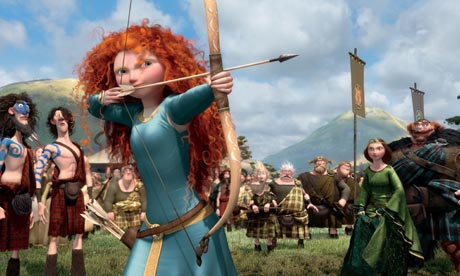
Jennifer Lawrence wasn't the only ballsy princess of 2012. We also had the flame-haired, cinch-waisted Princess Merida in Pixar's Brave, the studio's first female protagonist; plus Kristin Stewart riding, fighting, and shooting her way through Snow White and the Huntsman, not to mention her swan song for beloved Bella, now a momma grizzly protecting her vampire cub in the last Twilight movie. They all added up to "an interesting new breed of warrior princesses," said the New York Times' AO Scott, "whose ascendance reflects the convergence of commercial calculations and cultural longings."
Much of the credit must go to Lionsgate, who released both Breaking Dawn Part 2 and The Hunger Games, thus proving conclusively that young female actresses can 'open' and power a movie move way past the $100 million mark. "Girls actually need superheroes much more than boys," said Gloria Steinem, approvingly. Boys aren't the only ones to play Han Solo.
brave film still by pixar Princess Merida – and her bow and arrow – were big hits in 2012. Photograph: Pixar