Wednesday, April 28, 2010

Should UK ban Hollywood?

If you read the article on Bangladesh recently lifting, then putting back in place, their ban on Indian, Bollywood movies, you find a useful example of a small nation fighting to avoid being dominated by a much larger, economically powerful country (an example of cultural imperialism being resisted).
Read the article and, where it says Bangladesh, read the UK... [excerpt:]
Bangladesh's near-four-decade-old ban on movies from Bollywood has been reinstated after the commerce ministry's decision on Saturday to lift the injunction, in an effort to boost the country's struggling cinemas, was greeted with furious protests by local actors and directors.
Films from India have been proscribed in Bangladesh since 1972, the year after the country's independence, to protect the local film-making industry. However, the number of cinemas has fallen from 1,600 a decade ago to 600 this year, a decline which cinema exhibitors attribute to poor-quality homegrown films failing to draw viewers. At the same time, Indian films are hugely popular in Bangladesh and locals can get their Bollywood fix on cable TV and through pirated copies which circulate widely.
"Film enthusiasts can easily see good Indian films on cable television so why should we stop Indian films being screened in our cinemas?" Kazi Firoz Rashid, president of Bangladesh Cinema Halls Owners Association, told AFP.
"By contrast, the standards, scripts and production of Bangladeshi films are so stale and poor they have trouble winning hearts or making enough money," he said.

Should Britain ban Hollywood? Would this transform the fortunes of our film production companies? Or are we just too tightly tied into the US film industry to be able to go it alone? [If you read any history of UK cinema you'll find that there have been times when limits were placed on US films being screened, and/or a minimum number of UK movies set for cinemas...which Hollywood got round by producing ultra-cheap movies in the UK. This was as recently as the 1980s, when Thatcher ended the policy]

This article on Sacha Baron Cohen's latest deal is an illustration of why UK producers simply can't compete with the lavish scale available to Hollywood:

The Borat and BrĂ¼no creator's new comedy, where he plays a goat herder and a deposed dictator, has been snapped up in a lucrative deal after a bidding war
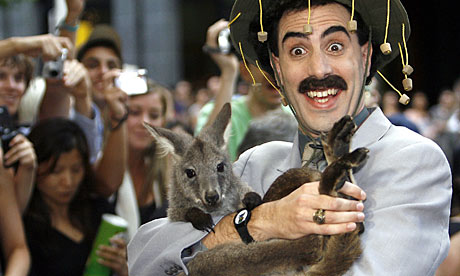
Sacha Baron Cohen with wallaby at Australian premiere of Borat
It's the quirky tale of a British comic, a Hollywood studio and a rare $20m offer to shoot a new movie. Oh, and don't forget the goat.
According to the Deadline blog, Sacha Baron Cohen's next movie has been snapped up by Paramount in a lucrative deal which instantly catapults him into the ranks of Hollywood's biggest stars. It will see the comedian play the dual roles of a goat herder and a deposed foreign dictator who finds himself lost in the US.
Paramount reportedly sealed the deal by sending a real live goat dressed in a studio T-shirt to Baron Cohen's LA home, after offering him a "20-20" deal. A rare phenomenon in an increasingly straitened Hollywood, this would give him $20m (£13m) upfront and an initial 20% share of the new film's gross, rising to 30% if the movie is successful.

The concept of films, and a film industry, being crucial for a nation's sense of identity and pride in itself can be seen with the tale of the record-budget $55m Russian movie that flopped. Seen as just too closely linked to the Russian government, the movie, and particularly its high profile director, lost credibility with the Russian public, and has initially taken a feeble $2.5m despite the nationalist narrative, portraying a Russian WW2 victory over the Nazis.   [excerpt:]
The premiere took place inside the Kremlin. Russia's prime minister, Vladimir Putin, did not manage to turn up. But Mikhalkov's fervent support for Putin and his strong Russian nationalist views are well known.
The film has many virtuoso setpieces but sticks closely to the Kremlin's approved version of the war: as the heroic Soviet triumph over Nazi barbarity.
This fact appears to have put the public off: the film has played to near empty halls, with box office receipts of just $2.5m from its opening weekend. Burnt by the Sun 2 cost a record $55m to make.
"The reasons it has flopped are psychological [not artistic]," critic Oleg Zolotarev said. "Mikhalkov is no longer seen as a director but as a state bureaucrat."

Monday, April 26, 2010

UK motion-capture studio?

The actor, whose performances as Gollum and King Kong were created through motion capture, is to head his own studio specialising in the technique

As he told a recent British Screen Advisory Council discussion on working with digital film technology, Serkis caught the bug of "cyber-thespianism" working with Peter Jackson at his Weta studios in New Zealand, first on The Lord of the Rings trilogy and then on King Kong. He has since directed performance capture for two video games, one in America and one in New Zealand. That made him wonder why the same facility wasn't available in Britain, when so much of the original technology was developed out of Oxford and Cambridge.
...

End of medium budget film?

I've touched on this before, the growing sense that mid-level Hollywood cinema is being squeezed out by tightening economics on the one hand and the Big 6's tentpole strategy on the other (making fewer movies, and concentrating on mega-budget blockbusters). Karl Sutter argues [NB: there is some strong language in this blog piece] that US cable TV (think HBO, home of The Sopranos, The Wire and many more) has become the new home for much of the talent that would previously have worked on $10-50m movies. [There is no set definition for low or medium budget movies]
It was Walt's observation that cable is now fulfilling the creative and compensatory void that has been created by film's dying middle-class.

Challenges facing UK directors

I've also linked to this in the post on women directors, which, like many others, I keep updating when I find useful new articles.

Good detail in this article on how the careers of British directors (Lynne Ramsey), and even the fate of one of our foremost film companies (Film4), can be turned upside down when Hollywood takes interest in a project which was all set to be directed by Ramsey for Film4:
[Ramsay] read [The Lovely Bones] when it was half an unpublished manuscript. Like many readers to come, Ramsay was gripped by the voice of a 14-year-old girl narrating her murder from beyond the grave. Film4 signed her up to adapt it.
But then several things happened: Sebold delivered the rest of the story, which departed into a gooey spirituality at odds with Ramsay's vision; the novel became a huge bestseller; and Hollywood heavyweights such as Steven Spielberg began to show an interest. Suddenly, The Lovely Bones was a potential blockbuster, and Ramsay's involvement started to look incongruous.
Meanwhile Film4 was downsized under new management. Its new head, Tessa Ross, was bemused to find herself courted by the most powerful players in Hollywood, all because of The Lovely Bones. Ross eventually bowed to the logic of the marketplace, and dropped Ramsay in favour of Peter Jackson. Jackson proceeded to make an utter mess of the film, but that's another story.
The article goes on to highlight the difficulties British directors face in building a career:
Next month sees the release of Philip Ridley's Heartless, his first film since The Passion of Darkly Noon in 1995. Richard Stanley is gearing up to shoot Vacation, his comeback after his career nosedived with his firing from The Island of Doctor Moreau, also in 1995. These two don't have the cachet of Ramsay or Pawlikowski, but they illustrate the general point that sustaining a career is much harder than starting one for many indie film-makers, particularly those with a distinctive vision. That's something the UK Film Council should bear in mind, as it concentrates its production funding on new directors.
As ever, there are some insightful comments following the article:
Does Ramsey make the sort of films that people want to watch these days?
I feel that stuff like Red Riding is far more relevant, look at its success in US. Made for TV, sold as movie in different markets - cool looking, genre movie deep in story, but routed in context (70s yorkshire in this case). I hope that '...Kevin' is like that, it certainly has the scope to be.
Ramsey's films have that 90s 'film council funded' feel to them, lot's of silence bookended with gritty and staring out of windows. Is that really going to put the British industry on the map right now? [jonaent, 22 Apr 2010, 1:13PM]


Tuesday, April 20, 2010

Perils of web marketing

Interesting article, which looks at the examples of movies which have sought to build appeal through silly titles which bloggers will pick up on, Snakes on a Plane being the prime example. Excerpt:
Once it's completed, Hobo With a Shotgun will become the latest film to join the ranks of that increasingly depressing sub-genre – the Deliberately Dumb Internet LOLZ movie.
You know the type of movie I mean. The one that doesn't have much of a budget and gets marketed purely on the fact that its title makes a handful of blogs get all ironically OMG about it for a couple of days. Snakes On a Plane started the trend in 2006 – by the time the internet heard that a) there was a film about some snakes on a plane called Snakes On a Plane and b) the internet had actively rewritten parts of it to make it even more stupid, then hype became so deafening that its success was all but guaranteed. Until it was released, that is, because then it became apparent that it would struggle to make its money back domestically.
But that didn't stop other producers from realising that if you give your film a ridiculously on-the-nose title, then the internet will go crazy for it. Just look at how it fell for Hot Tub Time Machine or the impossibly tedious Mega Shark Vs Giant Octopus when they were released. And soon there'll be Hobo With a Shotgun as well, lapping up the kind of online attention that YouTube videos such as Monkey On a Segway or Bear On a Trampoline did. Except that you'll actually have to pay to see Hobo With a Shotgun, and people tend to expect a little bit more than a funny title if they're actually going to cough up for it.

Thursday, April 15, 2010

The 1st iPhone movie

The first film made for the iPhone
Is this the start of a whole new cinematic genre? 
Ryan Gilbey 4 April 201
An early adopter of Murder on Beacon Hill
The torture of seeing films intended for 30ft cinema screens being squeezed into a 2.5in space has done nothing to deter millions of iPod users from downloading those burnt offerings. But now the traffic is heading in the opposite direction for the first time, with the screening next Sunday at the Boston International Film Festival of a 43-minute movie that was only ever made to be watched in the palm of the hand, and even then in bite-sized, site-specific instalments.

Sunday, April 11, 2010

Kermode: 3D is Rubbish!

Excellent Film Guardian article by Mark Kermode, fellow quiff-bearer, on the economic importance of 3D to the film biz, but also on why he sees it as basically a con.
There's an interesting comment too by 'chewtoy':
Call me paranoid, but the new 3D offensive has a much more sinister side to it than merely fighting piracy and getting bums into cinema seats. Cinematic immersion is a concept straight out of Brave New World. It's the extreme opposite of the Brechtian distancing (a.k.a. alienation) effect. The audience is meant to lose itself passively and completely in the depicted action, being transformed from consciously critical observers to mindless consuming drones.
This touches on a key debate within Media Studies (and amongst practitioners too; whole movements, such as the French New Wave, have come about as a response to the perceived power of the media over the audience): whether an audience is essentially passive and meaning is controlled by texts' authors (eg the hypodermic syringe model), or active and in control of meaning (eg the uses and gratifications theory).
The article:

Wednesday, March 31, 2010

More useful box office analysis from Gdn

Nanny McPhee sends Alice in Wonderland to the naughty step at the UK box office
In a fight for family film faces, Emma Thompson's Nanny McPhee and the Big Bang joined previews of How to Train Your Dragon in knocking off Tim Burton's Alice in Wonderland from the top UK box office spot


Easter is still a few days away, but the contest for the seasonal family box office is already well under way. Nanny McPhee and the Big Bang opened on more than 500 screens, knocking off Alice in Wonderland from the top spot in its fourth weekend of play. But it was a close-run thing, Nanny's £2.59m comparing with Alice's £2.50m. Both films might have been stronger had they not faced additional competition on Saturday and Sunday from paid previews of DreamWorks Animation's How to Train Your Dragon.

Monday, March 08, 2010

'Great' British Cinema?

Spotted a few useful items on YouTube
This is a trailer for a film24.com TV show on the poor state of the British film industry - does anyone have this by any chance?

As they feature strong language, I won't post links to these, but 'Save the British Film Industry (by Hamish MacDougall)' and 'Brit vs. U.S. Movies - Eddie Izzard' may provide a smile as well as food for thought - ditto 'Eskimo Nell (1975)', a good illustration of the poor state British film reached in the 70s.

Something we may look at time permitting is the popular usage of the British (usually English) villain in Hollywood and US TV productions ... how many examples can you think of? [please add any eg's as a comment]

Your thoughts then?

Wednesday, February 10, 2010

BritFilm used to campaign for social issues

Intriguing article over at your much beloved Guardian site: http://www.guardian.co.uk/business/2010/feb/09/tobin-tax-nighy-curtis-film
Richard Curtis is making some amends for giving Hugh Grant a career by getting involved, with Bill Nighy, in a campaign to add a tax to bank transactions (to fund developments in poorer nations), echoing his role in Red Nose Day (which was largely his creation).
RC naturally can't help himself and uses stereotypes to get his point across, but still...
Certainly a useful example for you A2 folk, and an intriguing addition to our AS case study of WT.
I'm curious as to how the right-wing papers (the Guardian being ideologically centre-left) will cover this, being ideologically opposed to regulation of the private sector/in favour of free markets. If anyone spots coverage of this, please add any details/a link as a comment.
The film, directed by Curtis, is being premiered on guardian.co.uk and YouTube.
Presumably The Guardian was selected as a paper likely to be sympathetic to the idea of raising taxes to help the poor (the tabloid Mirror would have been another option, as the only other centre-left national daily paper, though The Indy is also centrist in its political outlook).
I've embedded the short film below.

What do you think?

Tuesday, February 09, 2010

Archive of Brit comedy

See full article at http://www.guardian.co.uk/media/organgrinder/2009/may/29/pozzitive-web-comedy-steve-coogan-robbie-coltrane
EXCERPT:
Archive footage, audio and never-before-seen stills from some of the biggest British comedies of recent years featuring the likes of Steve Coogan, Robbie Coltrane, Julian Clary and Jack Dee will be made available to the public from today as part of a new website billed as the "online encyclopedia of British comedy".
The Pozzitive.co.uk portal, created by the independent production company and comedy specialist Pozzitive , will include 70 video and 100 audio clips, including trailers and out-takes, as well as 570 photos. These will include many behind the scenes pictures of hit shows such as Coogan's Run, Armando Iannuccio's Charm Offensive and TLC, which have been collated over 20 years by Pozzitive's founders Geoff Posner and David Tyler.
The pair, who set up the company in 1992, are two of the leading lights of British comedy, between them having worked on shows such as Spitting Image, Not The Nine O'Clock News, French & Saunders, Harry Enfield & Chums, Dinnerladies, Little Britain, The Paul & Pauline Calf Video Diaries, Absolutely, Saturday Night Live, Radio Active, Victoria Wood – As Seen On TV and The Young Ones. Pozzitive is also a specialist in radio comedy, with shows including Jeremy Hardy Speaks to the Nation, Another Case of Milton Jones and Cabin Pressure.

Monday, February 08, 2010

Audience tests + using festivals for distribution deals

There is significant overlap between the two points of the post title: every movie will go through audience testing before the final cut is released to cinemas (if at all); if the studio doesn't like the feedback they may re-edit or even order re-shoots under a different director (and in some cases simply refuse to sanction further spending on distribution other than as straight-to-DVD); film festivals are used by producers and distributors alike as informal forums for audience testing - good 'word-of-mouth' can transform a film's fortunes.
From the AS case studies we know that very small details can be crucial (the bewildered US audience, with an unamused Harvey Weinstein looking on, finally laughed as Colin Firth turns round to reveal his novelty reindeer jumper, securing a costly promotional campaign for Brisget Jones' Diary).

The typically low-budget Indie production, Four Lions, was recently entered into the Sundance Film Festival, a key event for Indie film-makers looking to find a deal to get their movies into cinemas or just a DVD release with some financing for marketing. Their diary is published on ... the Film Guardian! An excerpt:

[Sam Bain:]Back to the big event. Chris introduced the film (brilliantly) and as the lights went down it was gratifying to hear a lot of laughs, as well as the odd gasp as the story got more intense and the ­audience didn't seem sure whether they really should be laughing. Anxiety set in when I ­remem­bered just how many British references there are in the film – from Boots to Gordon Ramsay to Mini Babybels – not to mention the Sheffield accents which, unlike the Urdu and Panjabi dialogue, didn't have subtitles. But there was a genuine sense we'd grabbed the audience and they were very much along for the ride – and with absolutely no idea where that ride might end up. Exciting.
[Jesse Armstrong:] The screening goes well, but I find it excruciating. Sometimes when I'm scared of flying, I have this feeling like it's taking my full powers of concen­tra­tion to keep the plane in the sky. It's the same at the screening – as little pockets of laughs emerge here and there, I'm examining them for tone, timbre and implications. In my head I'm a sheepdog – circling the room wanting to shepherd people to draw the right inferences, go the right way.
Afterwards, I try to make a frank assessment of how the film has gone down. If it's possible for something to go rather well while simultaneously taking you repeatedly to the brink of throwing up throughout, that's what it felt like.
[Sam Bain]: The evening ended at about 4.30am with me and Mark Herbert listening to the Today ­programme piece on Four Lions, which included Robert Redford talking supportively about it. Who cares that he's not actually seen it? Most of the people who'll probably take a pot shot at the film in the UK press won't have seen it either.
 SOURCE: "Four Lions Sundance diary"
What happened when the co-writers of Four Lions, Chris Morris's 'jihadist comedy', took the film to Sundance? Sam Bain and Jesse Armstrong open their diaries
http://www.guardian.co.uk/film/2010/feb/06/four-lions-chris-morris-writers-sundance

Wednesday, February 03, 2010

Yorkshire on the big screen

A fantastic resource at http://www.britmovie.co.uk/2009/12/12/hollywood-yorkshire/ - an excerpt:
What image does Yorkshire conjure up for you? Rolling green hills and desolate moors, or gritty, industrial cities? The eclectic Yorkshire landscape, so full of contrasts, has long been a favourite for filmmakers. From Billy Liar to Calendar Girls, Yorkshire has played host to many famous films.

In a recent poll by the Film Distributors Association on the most atmospheric use of location in British cinema, four of the top ten films were set in Yorkshire, proving that Yorkshire has a rich and recognisable heritage in film. Despite Leeds being the chosen location for the first moving image film by Louis le Prince in 1888, it was perhaps the 1960s New Wave that really put Yorkshire on the cinematic map.

BBC doc on the British thriller

Haven't had time to test if its still plays, but came across this useful link to a BBC doc on British thrillers: http://www.bbc.co.uk/britishfilm/summer/documentary/thriller.shtml

Tuesday, January 26, 2010

Chris Morris' 'jihad comedy': a throwback to Ealing?

See full article (including clip from the film) at http://www.guardian.co.uk/film/2010/jan/25/four-lions-chris-morris
Excerpt:


Halfway through Four Lions, Chris Morris's dark comedy about a hapless British gang of wannabe suicide bombers plotting death and destruction in London, one of the antiheroes, surveying the aftermath of an unscheduled encounter between a co-conspirator and a flock of sheep, screeches, "Is he a martyr or is he a Jalfrezi?" It's one of the movie's great lines, and as it floated above the heads of a largely American audience unfamiliar with the nomenclature of Indian cuisine, the thought dawned that it asks a pertinent question of the movie itself.
  1. Four Lions
  2. Production year: 2009
  3. Country: UK
  4. Directors: Chris Morris
  5. Cast: Kavyan Novak, Riz Ahmed
  6. More on this film
Morris's brilliant work on The Day Today, Brass Eye and Blue Jam set the bar vertiginously high and his first foray into movie writing and directing arrives saddled with expectations. The story – which follows a Sheffield-based gang as they train, bicker, strategise, bicker, bicker some more and finally set off to London on their dastardly mission – is by and large engaging, and occasionally very funny. But you get the sense that the demands of cinema, namely a longer run time and the need for a linear, conservative story structure, have coerced Morris into sacrificing his anarchic vision in favour of a curry of not entirely complementary flavours.
By turns Ealing comedy, tragedy, thriller, buddy movie and satire, Four Lions isn't well served by the tonal shifts, but is always watchable for the performances of Riz Ahmed, Kayvan Novak, Arsher Ali, Nigel Lindsay and Adeel Akhtar as the jihadis. Their internecine warfare brings the biggest laughs, and there is much fun to be had from the trademark Morris doggerel; bilious, surreal convoluted outpourings coated in invective that spill out in Urdu (the gang switches between Urdu and English).

If anyone gets a chance to see this, I'd be interested to hear what they thought about it (just add a comment below)

[UPDATE FEB 8TH: see the co-writers' festival diary as they take the film to Sundance looking to find a distribution deal: http://www.guardian.co.uk/film/2010/feb/06/four-lions-chris-morris-writers-sundance]
[UPDATE 15TH APRIL: feature on Chris Morris; excerpt: 'The most sustained impression to date of his character, as well as his working practices, comes in Lucian Randall's new biography of the satirist, Disgusting Bliss: The Brass Eye of Chris Morris. Randall didn't get to interview his subject – that willingness to engage is far from universal – but, thanks to the co-operation of Morris's colleagues and acquaintances, he builds a portrait of a determined, uncompromising artist; loyal, generous friend and boss; and occasional pain in the arse.
His work is structured around the key insight that the ever-increasing presence of the camera in both public and private life legitimises or even occasions behaviour that would otherwise be recognised as absurd or harmful. Work predicated on this notion is now central to mainstream comedy, from the faux-documentary style of The Office to the various provocations of Sacha Baron Cohen and the persona of Stephen Colbert. Morris has done more to identify and skewer this cultural shift than anyone else and deserves wider recognition – whether he wants it or not.']

Saturday, January 16, 2010

WT & Warp web 2.0 Marketing

[I'm re-posting this from the AS blog, especially useful for any A2 students submitting coursework next month - with regards to issues of audience feedback and use of new media for marketing/distribution/exhibition]

You want to be examining the variety of tools employed by both companies through their own, and specific film, websites to promote their productions. So, follow the steps below:
1: look at the WT site and list all promotional tools they use (games, downloads, film features, wallpapers etc), being precise in your notes (so, don't just note 'games' but Hot Fuzz Pacman, as an example). Where you can, add brief notes on the likely target audience for these (you'll find some specific details through Q2 below)

Thursday, January 14, 2010

The Best British Film of 2009...?

The website RottenTomatoes.com has spoken on this:
Lone Scherfig's coming of age drama An Education was the best-reviewed British film, and also picked up an award for best drama. There was more UK success for Armando Iannucci's political satire In the Loop, which won best-reviewed comedy.
What do you think? Any comments with your own suggestions would be most welcome!

We're into the 'awards season', which can make fairly obscure films (that pretty much describes 99% of all British cinema!) become multi-million blockbusters, as was shown last year with the eventual success of Slumdog Millionaires (I've posted on this), which initially opened on a mere 10 screens in the US but went on to hoover up an incredible $141m after its Oscar nominations and wins.
The Guardian (who else?!) have of course been reporting on this; the BAFTAs kick off the award season and are often seen as a decent indicator of possible British success at the Oscars; see what you think of the BAFTAs selections:
Lone Scherfig's An Education is officially the frontrunner for this year's British Academy film awards, following the publication of the Bafta longlists. Avatar, The Hurt Locker and – perhaps the biggest surprise – District 9 also emerged as strong contenders. And Moon looks like the main rival to An Education for the title of best British film.
... Two years ago, Atonement was the most longlisted film, but ended up winning just two Baftas (though one was best picture). This year, An Education leads the way with 17 longlist entries (including seven in the acting categories alone), followed by Inglourious Basterds with 15.
... An Education is one of just two British candidates on the best film list, alongside Moon, bearing out the suggestion of a weak year for UK cinema. Bright Star, made in Britain by the Australian director Jane Campion, missed the best film cut but figured strongly in other sections. Andrea Arnold also made the director list for Fish Tank, and there were mentions here and there for Nowhere Boy, Damned United, In the Loop, Me and Orson Welles, Harry Potter and the Half-Blood Prince, The Young Victoria and The Imaginarium of Doctor Parnassus. But Ken Loach's Looking for Eric was notable by its omission.
(Source: http://www.guardian.co.uk/film/2010/jan/08/an-education-leads-bafta-longlists)


So...what do you think? What's YOUR best UK film of 2009? Did you actually see ANY or was your cinematic diet 100% American?! Has anyone seen Nowhere Man out of interest (a great example of a new director successfully using a short film as a 'calling card' which eventually won funding for NMan)?

Tuesday, January 12, 2010

Brit Cinema Since 1990 Ppt

This is a PowerPoint I came across when googling for something else; it is actually for the old A-Level but most of the info remains useful. Source: http://www.scribd.com/doc/20359588/British-Cinema-Since-1990

British Cinema Since 1990                                                                                                                                            

Good essay on British Cinema

SOURCE: http://fatmir-terziu.blogspot.com/2007/07/british-cinema-national-cinema.html (the following is an extract from this, use the link to read more)

BRITISH CINEMA A ‘NATIONAL CINEMA’


By Fatmir Terziu
There has been a considerable and encouraging growth in the study of British filmmaking over the years, but the question about British cinema in what sense is a national cinema is still complex. As Street pointed out “there is a British film industry with relatively clearly defined economic boundaries…and the cultural conception of what we mean by British films…” (Street, 1997:1). It can be said that five important themes have affected British filmmaking:
“Hollywood’s economic and aesthetic prominence; Britain’s weak production base; the stylistic and thematic variety of British cinema; the importance of class and gender; and …film culture” (Street, 1997:197).

This essay aims to analyse in what sense is British cinema a ‘national cinema’ and to discuss with reference to British films released during the past ten years.

Monday, December 21, 2009

TisEng sequel?!

UPDATE I.7.10 - TRAILER IS HERE! SEE http://www.guardian.co.uk/tv-and-radio/tvandradioblog/video/2010/jun/29/shane-meadows-this-is-england-86

It seems so:
'News of another British classic (also appearing on the Observer's Top 25 list): Shane Meadows is making the sequel to This Is England - as a four-part television series. The show will move the action on four years from the end of the film and bring back many of the main characters, including Thomas Turgoose as wannabe skinhead Shaun. Entitled We Were Faces, the series will be set in 1986 and finds Shaun preparing to leave school and enter the grown-up world.

Sunday, December 20, 2009

Viral marketing + UK box office analysis

If you got the Guardian on Friday you will have seen a rather handy feature on trailers and the experimentation that new media is allowing, especially as regards viral marketing campaigns and a shift away from trailers that reveal virtually the entire plot to much more enigmatic teaser-style trailers. No? Try http://www.guardian.co.uk/film/2009/dec/17/film-trailers then! Ties very neatly into the whole issue of marketing we were considering recently.
There's also a nice example, from a regular series, of a trailer being ripped apart for being ... well, read for yourself at http://www.guardian.co.uk/film/2009/dec/16/yesterday-was-a-lie-trailer-review (wee bit of narrative enigma there for you).
Another regular Film Guardian feature is in-depth analysis of box-office takings. The latest is an excellent overview of some of the key trends in release strategies, and contains much useful info on the arcane business of releasing movies in the UK, discussing the importance of digital 3D screens and the problems facing arthouse cinemas (with very precise screen/takings figures to reference), as well as the commercial failure of a spate of British releases. All useful material which you can read at http://www.guardian.co.uk/film/filmblog/2009/dec/15/a-christmas-carol

Just how many digital 3D-equipped cinema screens do you think there are in the UK? The answer shares the name of Zack Snyder's 2006 semi-animated epic...
And how many screens is James Cameron's $230m budget Avatar set to open on in the UK? I'm thinking this must be a record (the answer is 3 and a third times the previous answer) at about twice the typical figure for a UK number 1.

Hugh's he kidding?

Interesting appearance by the rom-com king and purveyor of the cliched stereotype of posh Britannia that defines the image many in the US in particular have of the UK's diverse population: Hugh Grant, sporting surely dyed hair, made a grumpy visit to Jonathan Ross' couch on Friday, which you can temporarily watch at http://www.bbc.co.uk/iplayer/episode/b00pgmzs/Friday_Night_with_Jonathan_Ross_Series_17_Episode_15/

Friday, December 18, 2009

Friday, December 11, 2009

Warp X comedy playing at Bradford NMM


Bunny and the Bull is playing at the National Media Museum between Fri 11th - Thurs 17th December. What better way to combine revision and relaxing?!


Bunny And The Bull Trailer Online

It's not a Mighty Boosh film per se, but here's one for the fans anyway, by the looks of things. Check out the trailer for Bunny and the Bull here.
Written and directed by Paul King, who was behind the camera for every episode of the TV Boosh to date, it's a fantasy travelogue, with the stylistic twist that we don't actually leave the protagonist's flat. Instead, Edward Hogg, co-starring with Simon Farnaby, recalls the trip from the comfort of home, and the visuals are filtered through polaroid snapshots and wonky recollections.
You can see the connection to the Boosh's papier-mache asthetic, and there are cameo roles for Booshers Noel Fielding and Julian Barratt, as well as the ace Richard Ayoade.
Is this the Shaun of the Dead to the Boosh's Spaced? Is Paul King's career set to follow the same trajectory as Edgar Wright's? [source: http://www.empireonline.com/news/story.asp?NID=26079]

Read Times review: http://entertainment.timesonline.co.uk/tol/arts_and_entertainment/film/london_film_festival/article6890778.ece 
See trailer: http://entertainment.timesonline.co.uk/tol/arts_and_entertainment/film/trailers/article6874073.ece 
Warp reports: http://warp.net/films/warp-x/bunnyc4
Another view: 'Bunny and the Bull, from the ultra-hip (is that good?) Warp X out of the UK, is another flick I've been clocking for a long time.. long before it's world premier was announced at TIFF. (See stills here) It premiered to positive reviews and unfortunately we haven't been able to catch it yet, but the first footage just dropped today in preparation for the upcoming London Film Fest which our own Ben Austwick will be covering. Howz it look? Sick, funny, and twisted. Me likey.' [source: http://www.quietearth.us/articles/2009/10/02/First-clip-for-Warp-Xs-BUNNY-AND-THE-BULL]

Tuesday, December 08, 2009

AS EXAM: SUMMARY OF BRIT CINEMA MATERIAL

[I meant to post this here, not on the AS blog, but need to post it again as there are some resits - and this material is useful for aspects of the A2. A2 students should also look up another post on the AS blog centred on marketing, which includes a range of PowerPoints on specific WT films: http://asmedia0910.blogspot.com/2009/12/marketing-wts-productions.html]

I'm hoping to revise the following docs, and provide briefer essay plans for the questions from the two sittings thus far of this exam, but to ensure you've got enough to work ahead on the following should help. If you want any of these photocopied let me know and I'll do sets for both classes.

PAST EXAM Qs:
JAN 2009
Section B: Institutions and Audiences
Answer the question below, making detailed reference to examples from your case study material to support points made in your answer.
2
Discuss the issues raised by an institution’s need to target specific audiences within a media industry which you have studied.
Candidates must choose to focus on one of the following media areas though you may make reference to other media where relevant to your answer.
- Film
- Music
- Newspapers
- Radio
- Magazines
- Video games


JUNE 2009
Discuss the ways in which media products are produced and distributed to audiences, within a media area, which you have studied.


There is already one update to add: NBC-Universal has been bought from its owners, GE (General Electric) by Comcast. They're buying a controlling 51% stake (leaving GE with 49% of the shares) for $30bn (thats £18bn) - though this creates such a large company that doubts have been raised as to whether it will be permitted.
See: Comcast to take control of NBC Universal
• Deal includes NBC's TV network and Universal Pictures
• Critics express concerns over monopoly and stifled creativity
plus:
Comcast-NBC Universal deal faces regulatory hurdle
Federal commissioner says tie-up faces 'a very steep climb' in effort to create powerful new force in American broadcasting
Plus the NBC-Universal section of the Guardian site

This is quite a detailed overview; it would be an idea to create your own, briefer version, but this is a useful resource nonetheless:
As Exam Brit Cinema Revision Guide                                                                                                                                            

This doc tries to specifically highlight the differences (and some similarities) between Warp and WT. If I get the time I will add the last three sections, but there is already a lot to work on in this:
Wt Warp Comparison Grid Draft1                                                                                                                                            


Sunday, December 06, 2009

EMPIRE - "INSIDE EMPIRE" special edition overviews mag's history


Especially for the A2 folk currently working on producing Film Mag covers/review pages, the "Inside Empire" edition is a useful resource, billed as "THE SECRET HISTORY OF THE WORLD'S BIGGEST MOVIE MAGAZINE", though it does provide an intriguing overview not just of the development of the magazine but also the movie industry throughout (and slightly before!) your lifetimes.
Critic Angie Errigo boasts that "historically Empire has a strong track record of loving young lions and getting behind promising newbies who went on to make good." Steven Soderbergh, Spike Lee and WT-produced Coen brothers are all cited as examples (Inside Empire (2009) "They do make 'em like they used to", p. 19).
The language used in the contents page quite clearly denotes this as a laddish mag, with 'the C-word' for example rather surprisingly used without any euphemism or asterisks, though this edition lacks the usual adult chatline ads at the back.
I've added the following excerpt from this to the http://mediabritishcinema.blogspot.com/2009/11/some-thoughts-on-digitisation-effect.html post -

Empire magazine critic Angie Errigo makes an interesting defence of the state of modern movie-making against claims that its filled with mega-budget tat that ignores narrative in favour of sheer spectacle (Inside Empire (2009) "They do make 'em like they used to", pp. 18-19).
A voice and a vision, and a reluctance to do what is expected are what's wanted in aspiring filmmakers. A-list stars and million-dollar explosions are completely optional if there's a story to be told, an emotion to be felt, a mood to be captured. Far from being a downbeat era of pap, these are wildly exciting times for all of us, rich with possibilities. Having entered the digital age with web access for all and an array of technology that gets cheaper by the minute, it's more possible than ever for movie brats to make their own productions and make them more ambitious and sophisticated than the Super 8 kids managed in their backyards. For every Hollywood film that costs upwards of $150 million, thousands of 'home movies' can be made and hundreds that are good to go in cinemas. It isn't naive to believe that 'talent will out'. The next Shane Meadows, Steve McQueen and Duncan Jones are out there at work within and without 'the System'.

 Super 8 is an old-fashioned format of video camera. If you've ever seen Son of Rambow imagine you were making your coursework with the same technology, a VHS video camera and two VHS machines linked up for editing (no digital technology at all, no computers even!).

UK Film Mag Circulations

Although there a range of smaller-scale, Indie rivals, the film mag sector in the UK is dominated by just two players, Empire and Total Film - both of which are published by major companies (Bauer and Future respectively - see the mags blog for info on Bauer), a conglomerate with global reach in the case of Bauer.
Both are quite Hollywood-centric, not especially going out of their way to reflect what the UK film industry is up to for its UK audience! Their covers routinely lead on some Hollywood star or director. Indeed, Empire ex-editor Phil Thomas is quite open on this:
Empire was set up to counter the pomposity of most film writing .... We took a different tack: movies are great until proven otherwise. Especially Hollywood movies.
The British film industry, such as it was, never really forgave us for that, but it was the 'critics' who loathed us most. They believed that every issue, with its Hollywood star on the cover and Barfing in the Movies features inside, was proof of Empire's agenda against serious European films, and our obsession with "propping up" Hollywood. As if it needed propping up.
(Thomas (2009) [Editors] "Phil Thomas", Inside Empire, p. 22)
Flick towards the back of each and look at the ads: all these invites to ring up young ladies for a nice chat suggests each sees the male reader as their primary demographic, a common assumption in both music and film publishing which I've always found a rather strange reflection of our culture (these companies are very, very good at knowing who reads their mags!).
The latest ABCs are out - figures are released monthly but half-yearly and annual comparisons are always paid particular attention to for highlighting trends. I'm sure you know by now that ABCs are how the official circulation (not necessarily sales) figures by the Audit Bureau of Circulation are known!
Here's the latest summary, from the excellent (though troubled itself; ironically the Media industry has struggled to support media on the media: The UK Press Gazette and MediaWeek the main players) MediaWeek:
IPC's NME and Bauer Consumer Media's Kerrang! reported year-on-year circulation drops of 27.2% and 28.3% respectively during the first six months of 2009.
In the film market, a special edition guest-edited by Steven Spielberg helped Bauer's Empire achieve a circulation of 194,016, up 2.3% period on period and 3.6% year on year.
The performance of Kerrang! and  NME reflected a market hit hard by the rise of digital platforms and changes in consumer behaviour. But Eric Fuller, managing director of NME publisher IPC Ignite, is committed to the title. "The paper publication remains in very rude health," he says. NME's website posted strong growth, for an ABCe of 4.7 million unique users in June.
Future Publishing's Classic Rock reported increases both period on period (0.2%) and year on year (5.5%) to 70,301. This is among a clutch of titles aimed at older music fans, including Q and Mojo, that remained steady despite market uncertainty.
SOURCE: http://www.mediaweek.co.uk/news/927666/ABC-SPECIAL-Heritage-music-brands-rocked-Music-film/

You can read further analyses at:
http://www.bauermedia.co.uk/Press-Office/News/ABC-Circulation-Figures-January-June-2009/
The world’s biggest-selling film magazine EMPIRE celebrates its 20th anniversary year with a sixth consecutive ABC rise to 194,016.
Earlier this year the EMPIRE team, led by Editor Mark Dinning, relocated to LA to work with the world's most famous film director and guest-editor Steven Spielberg. The special issue included exclusives from a veritable Hollywood Who's-Who - Jack Nicholson, Arnold Schwarzenegger, Tom Cruise, Mel Gibson amongst them.
http://dezji.wordpress.com/2009/08/13/uk-music-magazine-circulation-figures-to-jun-2009/
http://www.pressgazette.co.uk/story.asp?sectioncode=1&storycode=44141&c=1
A blockbuster packed six months in film has seen movie titles Empire and Total Film both post an increase in circulation figures.
Batman, Terminator, Harry Potter and Transformer sequels all released in the last six months must have contributed somewhat to a 3.6 per cent rise to 194,016 for Empire and a 0.6 per cent rise to 85,031 for Total Film.
Bauer's Empire scored a massive exclusive for its June issue, with legendary director Steven Spielberg guest editing the magazine's 20th anniversary edition.
http://www.guardian.co.uk/media/2009/feb/06/steven-spielberg-guest-edit-empire
http://www.guardian.co.uk/media/2009/aug/13/magazine-abcs-mens-womens
While many magazines suffered falling sales, the total average net circulation and distribution of UK consumer titles over the first six months of 2009 was 63.76m copies, a fall of 1.9% year on year.
http://www.guardian.co.uk/media/2009/feb/12/metal-hammer-overtakes-nme
http://www.guardian.co.uk/media/2009/feb/12/magazine-abcs-sales-slump-hits
Despite the doom and gloom, the magazine sector is still growing, with a total average net circulation and distribution of 81,227,572 across the second half of 2008, a 3.7% increase year on year and up from 76,238,115 in the second half of 2003.
The top-selling actively purchased magazine, relying on subscriptions and newsstand sales, was once again H Bauer's TV Choice, which sold 1,369,088 copies on average each week in the second half of 2008, down 2.5% year on year.
Two more weekly TV listings magazines sold more than 1m actively purchased copies each week – IPC's What's on TV, down 5.1% year on year to 1,315,543, and BBC Magazines' Radio Times, down 1.7% to 1,018,704.

Wednesday, December 02, 2009

Shane Meadows DVDs in Library


I've just added a Shane Meadows DVD boxset to the Library collection (for Media students only). The four films can be loaned out individually - see the pic for details or look up http://www.amazon.co.uk/Shane-Meadows-Collection-Twenty-England/dp/B000RWDY5O/

These are mostly Warp films, so obviously useful viewing for the AS, but also for A2; Shane Meadows has emerged as a key figure within Indie cinema in terms of (re-?)defining Britishness in the noughties

Be advised: The movies contain many challenging, quite adult scenes

Sunday, November 29, 2009

Warp to release zombie flick


See http://www.bigchill.net/news/2009/07/get-on-the-zombie-bus/ - Warp and C4 are producing a zombie flick. The genre seems to have gained a new lease of life (see what I did there...) of late, with the micro-budget Colin and C4's zom-com Dead Set (a disappointing effort from the Guardian's ultra-cynic columnist Charlie Brooker) coming on top of several high profile US efforts (including zombie godfather George A Romero's dire return), not to mention Shaun of the Dead and 28 Days Later/28 Weeks Later. Its been a long time since the UK has managed anything even close to the global status Hammer horror achieved through the 60s and 70s, but we may just be seeing an alternative to Hugh Grant's goshing and gurning developing here.
The new movie plays on the title of the notorious 80s 'video nasty' I Spit on Your Grave (which, sad to say, seems set for a re-make).
I've just watched the trailer (which features some swearing)...it looks utterly dreadful! Seems to star the annoying chap from The Mighty Boosh who has rendered Never Mind the Buzzcocks unwatchable with his annoying presence, and to have little in the way of an actual narrative. Ah well.

The Ghost of Rom-Coms Past Rises Again

Couldn't quite believe my bad luck when a wee browse through the upcoming schedule of releases in UK cinemas seemed to include the actor who sums up all that is bad about the representation of Britishness we get from contemporary UK cinema. Yes, despite announcing his retirement from film-making, Hugh, uh, ah, gosh, Grant is back - but there is hope...
He has threatened to retire at least twice before and now Hollywood actor Hugh Grant is talking about quitting acting yet again.

Blaming a string of stage fright attacks, the 48-year-old actor says he is ready to give up his day job at last.
I like everything about filming except the acting. Im wonderful in rehearsals, but I have never been very good when they actually switch the cameras on, he said.
In recent years Ive had really bad attacks where I totally froze up. I thought that well, if I am going to get stage fright, then I am packing it in, he added.
But people are wondering whether he is really serious about retirement because Grant has this habit of threatening to quit and then signing up a movie.
Grant admits that he is slightly embarrassed with his habit. His last talk about retirement came just months after completing work on Did You Hear About The Morgans?, his first film in two years.
SOURCE: http://blog.taragana.com/e/2009/08/17/hugh-grant-thinking-about-retirement-again-25254/
Hmmm...it actually gets worse. His new film co-stars Sarah Jessica Parker! Its just missing Madonna and Jennifer Aniston to complete this vision of hell! Surely an early favourite for the Razzies?

Schedule of New Releases in British Cinemas

Useful link this; you can see whats coming up, which has led to discover something really quite hideous - I'll reveal that in another post. See: http://www.launchingfilms.com/releaseschedule/schedule.php?date=today&sort=date