Friday, April 26, 2013

Screen Yorkshire 2013 £3.5m includes Warp's '71

News that Screen Yorkshire' Yorkshire Content Fund, launched in 2012, has a 2013 budget of £3.5m, investing between £100k to £500k in film, games and TV projects. Its total budget is £15m:
The Yorkshire Content Fund, launched in Feb 2012, will invest £7.5m of European Regional Development Funding into growing TV, film, games and digital business across Yorkshire and Humber. That figure will be matched by a further £7.5m of private investment, bringing the total fund value to £15m.
Much of Screen Yorkshire's money comes from an EU fund, the European Regional Development Fund. Here's SY's chief exec on how the YCF works:
Sally Joynson, Chief Executive of Screen Yorkshire, said: “We’ve had an incredible first year for the Yorkshire Content Fund with TV investments such as Peaky Blinders for BBC2 and The Great Train Robbery heading into production soon for BBC1, along with features such as Warp Films’ ’71, Emu Films’ Catch Me Daddy and Ecosse Films’ Girl’s Night Out. We now have a number of financing structures in place with co-investors that are working very well for the film and TV sectors so I’d urge producers to contact us now with their latest projects so we can continue to invest in the some of the most creative and commercial UK productions.”
Note the Warp Films movie in there: '71. You can discuss the funding of this (production practices) even if it hasn't been shot yet, let alone released (due for a 2014 release according to the IMDB entry). Here's the Wiki info on '71:
'71 is an upcoming film set in Northern Ireland. Written by Gregory Burke and directed by Yann Demange it stars Richard Darmer, David Wilmot, Martin McCann and Charlie Murphy, and tells the story of a British soldier who becomes separated from his unit during a riot in Belfast at the height of the Troubles in 1971. Filming began on location in Yorkshire in April 2013. The film is funded by the British Film Institute, Film4, Creative Scotland and Screen Yorkshire.[1]
Read more from SY's press release here.

Tuesday, April 16, 2013

Are stars vital for cinema success?

The simple answer is yes ... and no!
Most of the big hit movies are to some degree 'star vehicles', but then there are plenty of counter examples too, from Paranormal Activity to Bridesmaids, or Billy Elliot for that matter!
More and more films US and UK films are funded by pre-selling distribution rights to foreign markets, a strategy UK social realist filmmakers such as Ken Loach and Mike Leigh relied upon for most of their careers. In their case, they could pre-sell to European markets where they were held in very high regard as auteur filmmakers. More mainstream films, even at the low budget level, will frequently encounter foreign distributors demanding the presence of some star with appeal in their territory, reinforcing the position of stars as vital to a film's prospects even if the evidence of success is very questionable.
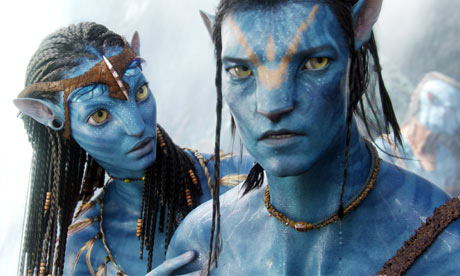
At the tentpole level there is also a yes and no answer: big name stars with wide international crossover appeal help sell the movie, and their appearances on major TV shows across different territories/markets, their presence at red-carpet openings, usually helps generate buzz. However, technology can be just as big a factor: Avatar wasn't reliant on big names but rather the combination of groundbreaking CGI/SFX and the brand of director James Cameron, just as Michael Bay's name and the associated guarantee of lots of spectacular explosions that the producer of such successful bilge as the Transformers franchise brings is at least as important as any star name attached.
Here's a few links for further reading on this - useful for reflecting on your own target audience too.

Michael Bay gets narked at Transformers star slagging off the movie!
After enduring the unenthused gripes of his two leads, Shia LaBeouf and Megan Fox, Bay has apparently been forced to his breaking point by the recent comments from Hugo Weaving, who called his voice-acting gig as Transformers villain Megatron a "meaningless" job that he "didn't care about."
EC McMullen Jr gets rather cross at the very idea that stars sell pictures, specifically horror...
Two major factors will sell your genre movie to the fans. One is someone and something they've never seen before (so if you're dry-humping NIGHT OF THE LIVING DEAD, ALIEN, or SAW, you lose). Two is fan recognition. Fans are more apt to go to a movie made by a director, writer, or producer (even a freaking

Universal launches $35k Prima Cinema: $500 tickets!

Prima Cinema has teamed with Hollywood studio Universal to offer the new service, which is targeted at super-rich film stars and other celebrities. The $35,000 price tag covers a digital box allowing movies to be delivered via the internet: once downloaded, they can be viewed just once at a cost of $500. Prima inspects every client's home cinema to ensure there are no more than 25 seats, so the service cannot be used to set up a commercial cinema business.
Universal is the only major studio currently offering its movies via Prima, but it is hoped others will follow suit if the service is found to be commercially viable. Upcoming films which will be available to view at home on the same day as their US cinema release include the Tom Cruise sci-fi thriller Oblivion as well as past titles such as Les Misérables, Identity Thief and Admission.
Universal is confident its latest strategy to combat the effects of online and home cinema on box office will reinforce its revenues - and it does seem a smart move. Basically, they're catering for the wealthy by offering $35,000 equipment that allows new releases to be viewed at home for $500 a pop. By 'home' they mean multi-million pads with space to accomodate a mini-cinema (up to 25 seats). The film is streamed, the latest use of digital distribution. They can verify that users don't seek to abuse the service with multiple screenings and ticket selling. See below for more info, from this article.

$35,000 kit allows super-rich to watch films at home on day they are released

Hollywood studio Universal is first to offer the service, aimed at film stars – with each viewing costing $500
Jurassic Park film, 1993
Home truths … a scene from Jurassic Park. Owners of the Prima Cinema equipment can see the 3D version at home this weekend. Photograph: MCA/Everett/Rex

The experience filmgoers have been waiting for since the dawn of Hollywood has arrived: the chance to see new releases at home on the same day they hit cinemas. There is, however, a catch: to view Jurassic Park 3D this weekend you will first need to install projection equipment costing $35,000 (about £23,000), while each viewing costs $500 a pop (£330).

Digitisation and the piracy debate

TBC
Is the piracy debate overplayed by the film industry?
Are the ads starting every DVD which link film piracy with organised crime likely to impact on youth - or perhaps the alarmist message is aimed at politicians, not consumers? Then there is the Industry Trust for Intellectual Property Awareness £5m campaign, Moments Worth Paying For (backed up with a UKFC/National Lottery funded website, "findanyfilm.com", which locates legal DVD/download links for any film. [source]
Its also arguable that the legal moves against the likes of Kickass Torrents are tokenistic.
Look more closely at what is being pirated - its the Hollywood productions; only highly marketed British productions are likely to appear on the likes of Torrent sites (the likes of a Loach movie is unlikely to attract many 'seeds'!). [source]
Some users feel justified in pursuing piracy given the distribution strategies of the majors: only sending cinema prints to the UK after the US run has finished (the rare exceptions are films like Avatar which are given an incredibly expensive worldwide release). Plus, many British films simply won't make it to cinema screens. Then there's the pricing of cinema tickets, and the increasingly poor cinema experience, blighted by smartphone wielding youth. Cineworld's targetting of 35-44+ through
luxury food etc suggests an alternative strategy to lawsuits, as do the wave of streaming and download options becoming available.

Sunday, April 14, 2013

3D declining in 2013

You can find much more on the key topic of 3D cinema in this post.
Back in 2011 there were some arguing 3D would soon decline - and now it seems it may have peaked.

3D films set for popularity slide

First drop in 3D box office projected for this year despite hotly tipped summer blockbusters, according to Fitch Ratings report
Avatar
Box office blues … 3D exploded into our cinemas with Avatar in 2009, but now the novelty appears to be wearing off. Photograph: Rex Features
Audiences for films in 3D are projected to decline in 2013, the first drop since 3D exploded with Avatar in 2009, according to a report compiled by Fitch Ratings.
Since the success of James Cameron's sci-fi epic, more and more movies have jumped on the latest iteration of the 3D format, which is no longer confined to animation or big-budget action films. The likes of Baz Luhrmann's The Great Gatsby and Alfonso Cuarón's Gravity will also exploit the new technology.
However, Fitch has concluded the novelty is starting to wear off. 3D box office takings in the US and Canada have remained static at $1.8bn for the past two years, and are set for a slight year-on-year decline in 2013 despite a strong lineup of 3D releases, including Star Trek Into Darkness, Iron Man 3 and Man of Steel.
"Attendance likely benefited from the initial proliferation of 3D films," says the report. "However, the initial excitement has dwindled, and consumers are focused again on the overall quality of the film and are weighing the cost of a premium ticket versus a base 2D ticket."
While overall box office takings increased in 2012 to a record-breaking $34.7bn worldwide, 3D failed to make a similar impact. "Going to the movies remains one of the lower-cost forms of entertainment," says Fitch's study. "However, increased pricing, particularly on 3D films, may erode this perception over time."

VDIO: will streaming replace cinema?

The short-term answer is no, given what huge businesses cinemas are ... but then the CD market, and the high-street retailers linked with this, seemed bullet-proof not so long ago and even HMV has gone bust, with downloads long since passing physical CD sales.
Vdio is the latest launch of a company seeking to develop film streaming in the UK, but for now their prospects are limited by the absolute determination of the exhibitors to protect the exclusive cinema window. Netflix has recently pioneered releasing TV series in one go, before they've aired on TV, so its likely this will eventually happen with cinema too. IMAX, 3D and the huge improvements in sound are all defensive moves by cinema to protect its appeal with customers who can download movies to watch on phones, tablets, computers or home cinema setups, but they do face huge and growing pressure from online distribution - especially now 4G broadband is here and GB file sizes no longer rule out film streaming/downloads for most.

Here's an excerpt from Stuart Dredge's article on this, Vdio streaming TV and film service goes live in the US and UK (4.4.13):
In other words, TV shows and movies are bigger than songs, which for a while meant piracy was less of a headache for rightsholders in those industries than in music – although faster broadband connections and better data on the scale of TV and film filesharing is changing that.
Even so, by protecting the idea of release windows – where shows and films get staggered releases through cinema/TV, DVD/Blu-ray and digital services – startups like Vdio have to license content where they can.
"They've embraced digital, it's not like they haven't," says Larner. "There are a ton of digital services out there. But movies and TV – and movies especially – are holding on to their windowing as long as they can, to squeeze as many dollars as they can out of the initial theatrical release, then the other windows."
For now, Vdio will focus on refining its technology for buying and renting, ready to add subscriptions when it thinks the time is right. Larner says the company is also focused on expanding the number of devices Vdio is available on, including TVs.
"For a video service, it's critical to be on the TV. Right now, Vdio is web and iPad, and the way to get on TV is you need to take your iPad and use it with an Apple TV, which is a great experience," he says.
"But no doubt about it, we need to be on TVs in other ways, and we have that on the roadmap, whether it's [set-top box] Roku or doing apps for Samsung or LG TVs. We need to be there."

GLOBAL BOX OFFICE: continued US dominance?

Figures for the following are taken from Phil Hoad's article, Hollywood's hold over global office - 63% and falling (2.4.13), itself based on this MPAA annual report. Figures are for the full year 2012.
Worldwide box office: $34.7bn
US $10.8bn
non-US global box office = 69% of total (ie, US = a third of all global box office)
Asia-Pacific box office jumped 15% to $10.4bn, with China overtaking Japan as world's 2nd-biggest market (Hoad argues that it won't maintain the 36% rise every year + so rejects the argument that it will overtake the US by 2020)
'One thing beyond dispute is that Asia-Pacific is poised to overtake the EMEA region (Europe, Middle East and Africa), which shrank slightly last year to $10.7bn, very soon.'
'The third region used by the MPAA for global box-office purposes – Latin America – logged a small rise, from $2.6bn to $2.8bn.'

Crucially, note that these figures are for tickets in those regions - US-produced films continue to dominate worldwide, hoovering up nearly 2-thirds of global box office (60-70%) - see below for more details. That actually means a steady fall since Avatar set the recent high in 2010, although 4 of the big 6 made over $2bn from non-US box office in 2012!

A lot of figures, the point is that these provide useful, specific evidence of the context of US dominance in which UK companies must operate.
The MPAA report is still, sadly, low on detail on overseas activity, despite abroad being where Hollywood's compass points these days. It certainly doesn't broach the touchy question – loaded with the old cultural-imperialism chestnut – of exactly what level of dominance Hollywood enjoys worldwide. So, using Metacritic's figures for respective studios' takings in 2012, I've done some calculations of my own. If worldwide box office was $34.7bn, and the six majors' combined box office was $21.773bn, that means American cinema enjoyed a minimum 62.7% share of the globe (this doesn't take into account films by smaller producers, including Lions Gate, which is virtually a proper studio now). Applying the same methods for the previous three years, the percentage comes out as: 2009, 63.9%; 2010, 67.4%; 2011, 66.9%; 2012, 62.7%.
Does this four-year snapshot mean anything? It certainly reinforces that the US remains the 900lb gorilla of world cinema – gripping what, if complete stats were available, would probably be closer to 70+% of all box-office receipts. But Kim Jong-un and devotees of cultural diversity can also comfort themselves with the fact that this share seems to be dropping – from a 2010 peak when Avatar skewed the spread – at a time when overseas markets are expanding rapidly and the studios are straining to devise "global content". And the drop was a fairly dramatic one in 2012, despite a fair performance across the board from the big six (four made it over the $2bn mark in international markets), and a year that contained a No 3 entry for Disney, Avengers Assemble, on the all-time list. So this shows why the MPAA flapped so hard about the Chinese government's anti-competitive practices – forcing US blockbusters to run off against each other on the same weekend, and blackout periods for foreign releases. As new cinema markets become larger and more sophisticated Hollywood will have to fight harder to retain the status quo.

Saturday, April 13, 2013

2011 UK Cinema report: key facts

Each year the BFI (British Film Institute, who have taken over duties from the UKFC) publishes a report on the UK film industry, highlighting trends and changes: the share of UK productions v US-backed UK productions v Hollywood imports; the share for Indies; the box office % for 3D; the rise of digital production etc, and more.

Below, I pick out the key points and include analysis (+ further links/quotes) to help you include this in your exam prep. There's a full list of definitions at the very end, but this one is especially useful: A UK film is a film that has been certified as British by the DCMS or by the Certification Unit of the BFI (acting on the authority of the Secretary of State for Culture, Olympics Media and Sport) or which is a de facto UK film by virtue of being made in whole or part in the UK by a UK production company. You can see from this that the definition of a British film, as far as the government is concerned, includes basically US films which are partially shot in the UK. Both Warp and WT are treated as British companies, despite WT being majority-owned (67%) by NBC-Universal
Here's some links to their latest reports:

Statistical Yearbook 11

The 2011 Statistical Yearbook offers the most comprehensive and accessible picture of film anywhere in the UK
New reports
Statistical Yearbook Archive
Our Publications A-Z contains a pdf archive of all of our Statistical Yearbooks to date:
------

SOME KEY POINTS FROM THE REPORT

The points/data below are taken from Film production in the UK - full year 2011 report (76KB, PDF), 31 January 2012 - I've also added some further analysis and links.
  • Admissions (the number of tickets sold) rose to 171.6m
  • the total box office from this was £1.4bn, up 5% from 2010, with Indie hits The King's Speech and The Inbetweeners Movie a key factor: both took over £45m  making them the biggest UK Indie hits ever
  • Harry Potter and the Deathly Hallows Part 2 became the 3rd biggest UK hit of all time with £73m after Avatar and Toy Story 3
  • there were 6 movies over £30m (compare that to the US where many of the top 10 in a typical week will have exceeded that), the above + Pir.Carbn: On Stranger Tides; The Hangover 2; The Twilight Saga: Breaking Dawn Part 1. Its unusual for big 6 flicks not to take the top spots!
  • the surprise £23m success of Bridesmaids showed the strength of female-centred movies [DB: prospects for a 3rd BJD movie look good right now]
  • WT's biggest UK hit was #12: the £20.6m (1 of 13 in UK to top £20m) Johnny English Reborn (its final total is higher still, as it overlaps with the 2011 figures), tho' parent company Universal also had #9 Bridesmaids and #14 Fast and Furious 5
  • WT also had #12 in 2010 with Nanny McPhee and the Big Bang (£16.53m) - this shows the importance of franchises to film producers and distributors; again, with BJD3 imminent this trend is not going away
  • over the past decade UK films account for 24% of UK box office, but 18% of this is US-financed productions; only 5.5% of UK box office came from UK Indies - that average was doubled to 13.5% in 2011
  • WT are classed as a UK Indie, which suggests that the genuine % for actual Indies is much, much lower! Tinker, Tailor, Soldier, Spy was the 3rd biggest 'UK Indie' hit of 2011. Warp X made it into this chart, #14 with the brilliant Submarine (£1.46m); Four Lions was 5th biggest Indie hit in 2010. Only 5 'UK Indie' releases earned over £5m in 2011, again showing why their releases rarely exceed £5m in budget
  • The Harry Potter sequel took 48% of its money from 3D screenings. There were nearly twice as many 3D films as in 2010, 3 times as many as 2009 ... BUT, perhaps the 3D bubble is finally bursting? In 2010 3D took 24% of UK box office, this was down to 20% in 2011. More and more '2D-to-3D conversions' (where software is used to reprocess films not shot in 3D into 3D) are being released, and perhaps the novelty is wearing off - maybe Avatar will prove the absolute peak of 3D? While you can still double ticket prices, though, 3D will remain a tempting proposition: right now a 3D conversion of The Phantom Menace is doing well worldwide, and Titanic is soon to be re-released as 3D as well. We've yet to see any WT 3D (and its far too expensive for Warp to consider). Cinemas have been desparate to compete with the growing trend of home cinema, expensive large-screen/surround-sound living room set-ups that many people now use in preference to cinema, with its (sorry, but its true!) noisy teens, over-priced tickets and horrid food:
Cinemas are obliged to split money from ticket sales with the film studios, but get to keep almost all the cash they make from selling food. That means that the "concessions" (popcorn, sweets and the like) make up 20% of a cinema's revenue but 40% of its profits. A box of popcorn is around 85% profit to the cinema, and salty foods of course encourage people to buy more soft drinks, increasing receipts further. "Without the hefty concession profits," declared an article in Time a few years ago, "there would be no movie theater business". (http://www.guardian.co.uk/lifeandstyle/wordofmouth/2012/mar/07/cinema-snacks-a-view-to-a-killing)
see also prev posts on 3D/digitisation:

  • Despite the apparent promise of digitisation to open up the film industry to low and micro-budget productions, with reduced distribution costs also helping, the number of films produced in the UK in 2011 actually fell from 322 (2010) to 237. In 2010 there were 184 UK films made for under £500k, in 2011 just half that at 98, again, not what we expect from the benefits of digitisation. Will the closure of the UKFC further damage the prospects of low-budget UK Indie releases in 2012? The total spend (all the budgets added up) actually increased slightly, to £1.26bn, though most of this was US money.  


The terms used by BFI:

A UK film is a film that has been certified as British by the DCMS or by the Certification Unit of the BFI (acting on the authority of the Secretary of State for Culture, Olympics Media and Sport) or which is a de facto UK film by virtue of being made in whole or part in the UK by a UK production company.
A US studio film is a film that is produced in whole or part by one of the major US studios or one of the major US studios’ specialist subsidiaries.
An independent film is a film made by an independent production company or group of independent production companies.
US studio films are generally distributed in most territories by the parent studio. Independent films are usually distributed by different distributors in different territories. 
[Source: The UK box office in 2011 (112KB, PDF), 31 January 2012]

Tuesday, March 26, 2013

Danny Cohen on Les Mis cinematography (Kodak blog)

Taken from Kodak's About the Storyboard blog, which is obviously a promotional tool + thus pro-analogue film but still a very useful resource for the flipside to the pro-digital arguments, you may find some of this (an interview with Danny Cohen) familiar from Cohen's seminar at the 2012 ASFF...
See http://motion.kodak.com/motion/About/The_Storyboard/4294971312/index.htm.

Sample quote:

The filmmaking team also did quite a bit of testing, comparing different mediums. ... “In the end, for a variety of reasons, we chose 35mm film. What film has over digital is that it’s organic, it’s slightly softer, and there’s grain. There’s a certain sharpness to digital; you can treat it, but if you shoot on 35, what you see is what you get. You get an amazing image without a lot of post production.
“We shot well over a million feet of film ..."

Thursday, March 14, 2013

UK Film uses Kickstarter

News of a UK example of film producers seeking finding via Kickstarter rather than through the traditional channels. Warp's Mark Herbert also raised this as something they would be exploring in future too.

UK video games industry movie turns to crowdfunding for a second time

UK video games industry movie turns to crowdfunding for a second timeBen Parfitt
A film that hopes to tell the story of the UK video games industry has arrived on Kickstarter – the second time it has sought funding from crowdsourcing.
From Bedrooms to Billions has already been successfully funded on Indiegogo, but filmmakers Anthony Caulfield & Nicola Caulfield have now turned to Kickstarter for additional funding. £18,000, to be precise.
“In 2012 we successfully ran our first crowdfunding campaign which allowed us to begin the principle photography, so we've been filming almost continuously throughout 2012 and are very close to completing all filming in 2013,” the pitch reads.
“However as is common with many films financed via crowdfunding, money is now needed to complete post-production, to secure archive footage, stills, music usage and clearances. Without these crucial elements the film would simply be two hours of talking heads and not the true and lasting documentary movie experience that the subject matter deserves.”
Quite how the team can describe its Indiegogo campaign as “successful” when it has now turned to Kickstarter for more money is open to question, although they argue that they “always wanted to run separate campaigns for the production and the post-production budget”.
Nonetheless, the aim remains to finish the two-hour film which tells the story of UK gaming from 1979 to the present. It has been in production for ten years and has amassed footage from interviews with the likes of Matthew Smith, David Braben, Gary Penn, Rob Hubbard, Julian Rignall, Martin Galway and Jeff Minter.
“From Bedrooms to Billions has been a very personal project for us since June 2008,” producer Anthony Caulfield stated. “Having completed many documentaries we have always wanted to document the rise of the British video games industry and the incredible story that went with it.”
Fellow producer Nicola Caulfield added: “This film will be a great piece of nostalgic entertainment that documents an important part of UK history. This era is so often overlooked and not known by young British talent looking to enter the games industry, as the vast majority of UK children, school leavers and even students believe that gaming originated mainly from the US and Japan and have little to no knowledge that a British games industry even once existed.”

Tuesday, March 12, 2013

Digitisation: links + points from past posts TBC

In no particular order for now:

[TOWID: The Only Way is Digital] UK download revenues (includes music, TV and video games) topped £1bn in 2012; will Skyfall's record of topping £100m UK box office ever be beaten ... is cinema facing a decline on the level of the press and music industries?

[Hollywood encourages piracy?] Hollywood's treatment of online renters/streamers is encouraging piracy argues David Pogue in The Scientific American.

[NEW: DPunch dir Olly Blackburn on HD advantages over film] "Of course there’s still a place for film, I love film, just because it looks beautiful. I was trained on film, I edited film with a knife! I love working on film, but I had such a good experience of working on HD here. If a low budget film uses this technology, the [possibilities] are endless. Much of that comes from working in commercials, you find yourself in the cutting room wondering what this button does, or that one. If you have the right people working on a low budget digital film, you can come up with amazing things. I’d recommend it to younger filmmakers."

[NEW: All Tomorrow's Parties] Interesting as an example of digitisation in full effect: ‘All Tomorrow's Parties is a 2009 documentary film directed by All Tomorrow's People and Jonathan Caouette covering the history of the long running All Tomorrow's Parties music festival. Described as a "post-punk DIY bricolage", the film was created using footage generated by the fans and musicians attending the events themselves, on a multitude of formats including Super8, camcorder and mobile phone. All Tomorrow's People is a name representing the contributions of these attendees.’
Furthermore, it inspired 4 short film projects funded through Kickstarter.com in 2011, the online site where you can post a pitch and seek funding: http://www.kickstarter.com/projects/613961261/from-atp-four-short-films-by-vincent-moon  [Wiki].

Thursday, February 21, 2013

Sky's the Limit? 4 of big 6 on exclusive deals

The headline of the story I got this info from centres on Disney (Sky Movies Disney: new channel to show UK TV film premieres, Jason Deans, 21.2.13), but the bigger story is that Sky, a News Corp (Murdoch's global conglomerate) subsidiary, has now got 4 of the big 6* signed up to exclusive deals.

*Yes, this may in time switch to the 'big 7' with Lionsgate joining the party, but for now lets stick to the 6!

I knew someone would have thought of this!
Thats a very big deal so far as UK exhibition goes, giving Sky a virtual stranglehold over TV rights - precisely the sort of monopoly that the ultra-free market Murdoch claims to be against (we explore such economic issues more in A2 when looking at media regulation). Given the multiple ways you can access a Sky subscription, including on iPads, its also typically clever if cut-throat business practice from Murdoch, reflecting a similar approach to football: Sky built up its subscriber base by monopolising Premership football coverage and taking it off free-to-air PSB networks (BBC, ITV, C4, C5). He's successfully seen off challenges from ITV Digital in the past (illegally leaking the hack code for its subscriber cards according to a 2012 documentary), and is now faced with potentially stiff competition from streaming services such as Netflix.
The deal also gives Sky access to Disney films for its video on demand services Sky Go, Now TV and On Demand.
Sky declined to reveal the length of its new Disney deal. But in the face of increased competition for Hollywood movie rights from US VOD service Netflix, which launched in the UK in early 2012, Sky has now renewed exclusive pay-TV deals with four out of the six major studios – Disney, Sony, Universal and Warner Bros – since September.
The deal includes Disney's newly-acquired subsidiary Lucasfilms, which means Sky have exclusive pay-TV rights to the upcoming Star Wars sequels.

Its also an illustration of how the majors retain and reinforce their dominance; the likes of Warp aren't likely to be invited to negotiations for an exclusive deal with Sky any time soon!
Although Working Title is effectively an NBC-Universal subsidiary, it is not included in the deal, meaning they still have to negotiate film-by-film distribution and exhibition deals.

Friday, January 18, 2013

TOWID (The Only Way Is Digital)

2013 is clearly set to see digitisation continue apace, with analogue media being displaced by digital media which are typically cheaper to produce and distribute. That doesn't mean that analogue media, such as films shot on 35mm and distributed as 35mm prints to cinemas (each print costing £000s), will disappear, but that bit by bit the industry is moving over to digital content.
Here's some useful stats from this article, about Google buying a 10%, $50m stake in the video distributor Vevo (the joint Sony/Universal venture that you'll have come across if you've watched a few videos on YouTube, given how much of the music industry their artist sales represent):
Earlier this month the Entertainment Retailers Association reported that downloads of music, TV shows, films and video games topped £1bn in the UK for the first time in 2012. Digital music sales grew but revenue from physical singles fell by 44% year on year and albums dropped 11%.
The cinema industry and CD sales remain strong but, like newspapers, which are also seeing circulation declining rapidly as more people access their news online, may not have a bright future. The record set by Skyfall, 2012's Bond movie, may never be beaten: it became the first movie to take in over £100m at the UK box office by the last week in December 2012 (it was already the biggest ever UK cinema hit, and topped $1bn worldwide).

Friday, January 11, 2013

Film/Ideology: Superman's global message

Great article here which amply demonstrates the deeper ramifications of popular culture; delves into the hegemonic connotations of fictional entities such as Superman, shortly to be the subject of yet another film, Man of Steel. Sample quote:
"He is the first global superhero," said Larry Tye, author of Superman: The High-Flying History of America's Most Enduring Hero.
Indeed, Superman's influence is so great that he is spearheading the growing academic study of comic heroes and their role in society. Such figures are seen as fulfilling the same societal function as the myths of ancient Greece or Rome. They are outlandish creatures doing battle for high ideals and teaching us moral lessons. "We need myths to teach us virtues. Eventually those virtues need to be embodied by a person. Mythology has always played that function," said Professor Harry Brod, a philosopher at the University of Northern Iowa.
Some have taken the point of the moral teachings of Superman stories further, seeing a powerful philosophical concept behind them. In his book Saunders devotes a chapter to Superman, in which he suggests that the character's immense popularity is a result of his embodiment of goodness. "In terms of 20th-century popular culture, he captures the notion of a Platonic ideal of the good. When Superman is done well, I am not embarrassed to call him a beautiful idea," Saunders said.
See SpiralGroove.com: Superman + the American Way
Other experts in how human cultures work go even further in their efforts to explain the extraordinary longevity of the Superman figure.
The 2006 film that made Superman into a Jesus Christ-like figure was perhaps closer to the core of Superman than any other depiction. Just take some of Superman's main attributes. He descends to Earth from a world far away up in the sky. His true father passes him advice as he walks among mere humans.
Read the full article below.

Saturday, January 05, 2013

Cinema in 2013 will be...

Lengthy feature, broken down into shorter themed sections, from the Gdn Film Blog (if you don't already follow it you should!) here on what 2013 will bring for the cinema industry: read the article here or (partially reproduced) below.  

Care to add your own predictions as a comment? Will the 3D boom continue or tail off? Will home cinema 3D once again undermine cinema? Will streaming overtake DVD sales as a source of revenue? Will the window between exclusive theatrical exhibition and DVD/TV/streaming continue to shrink? Will the US audience continue to shrink as a % of Hollywood revenues for its own films - and if so, will this lead to greater multi-ethnicity in the casting of leads, or a shift away from depicting American power (surely a key tool of US political hegemony)? Will digitisation open up greater opportunities for Indie producers ... or will the tentpole strategy (closely tied to franchising sequels, prequels and remakes/reimaginings) continue to maintain big 6 global dominance? Will YOU go to see any film in the cinema in 2013 - or turn increasingly to viewing film on tablets, laptops etc?

Brits in Spandex and girl power: movie trends that will keep us talking in 2013

Last year, Hollywood was flush with international cash and films starring Matthew McConaughey. What will this year hold?
Angelina Jolie as Maleficent
Angelina Jolie as Maleficent represents the latest trend for Actresses of a Certain Age Who Aren't Really That Old: playing the bitch. Photograph: Disney

Time travel was popular. Prequels were hot. As were guns-for-hire, vampires and movies set on boats. Which of the year's cinematic trends, people, cultural avatars and epiphenomenon are most likely to set the agenda for 2013?

Jennifer Lawrence

In X-Men First-Class, Jennifer Lawrence wore the lightly stunned look of someone suffering from an acute case of Newcomer Bends. But then she narrowed her eyes, strung her bow and fired The Hunger Games towards $686m: Lawrence's imperturbability was revealed as the genuine article. The scene in Silver Linings Playbook where she walks into de Niro's lair and has him eating out of her hand in under five minutes may just win her an Oscar at the tender age of 22. If that weren't reason enough for New York magazine to put her at the top her their "Celebrity Brunch League" – the lost of famous people they'd most like to have pancakes with – the editors listed a few more:
She complains about her fussy premiere clothes; she crashes into cars while looking for Honey Boo Boo. There was that time that her entire family went to Sleep No More in search of orgies … Jennifer Lawrence cannot be contained by your Movie Star Rules of Decorum; Jennifer Lawrence has too much to share.
We concur. She's like Liz Taylor without the alimony.

Girls

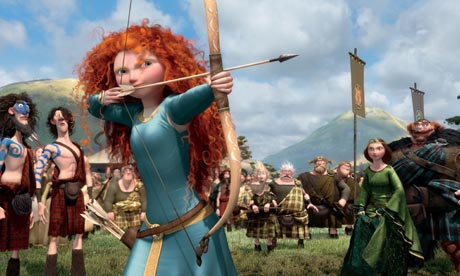
Jennifer Lawrence wasn't the only ballsy princess of 2012. We also had the flame-haired, cinch-waisted Princess Merida in Pixar's Brave, the studio's first female protagonist; plus Kristin Stewart riding, fighting, and shooting her way through Snow White and the Huntsman, not to mention her swan song for beloved Bella, now a momma grizzly protecting her vampire cub in the last Twilight movie. They all added up to "an interesting new breed of warrior princesses," said the New York Times' AO Scott, "whose ascendance reflects the convergence of commercial calculations and cultural longings."
Much of the credit must go to Lionsgate, who released both Breaking Dawn Part 2 and The Hunger Games, thus proving conclusively that young female actresses can 'open' and power a movie move way past the $100 million mark. "Girls actually need superheroes much more than boys," said Gloria Steinem, approvingly. Boys aren't the only ones to play Han Solo.
brave film still by pixar Princess Merida – and her bow and arrow – were big hits in 2012. Photograph: Pixar

Wednesday, October 03, 2012

Web-Only film: Microsoft's Halo 4

Cinemas have had to compete with TV, DVD, piracy and the increasing quality and affordability of home cinema setups. Now some film producers are ignoring cinema altogether and pioneering web-only releases for relatively high budget productions, with computing giant Microsoft's web-release of Halo 4 suggesting this could be a growing trend. Released as 5 15min episodes over a 5 week period (each launching once a week on YouTube), the budget is higher than for many films that will get cinema releases.
As the article notes, there have been several examples: 'Warner Brothers recently aired a web-only series based on Mortal Kombat, as did Ubisoft with Assassin's Creed, the latter currently being redeveloped as a film without a Hollywood studio. It is not only games, either. A new series of Arrested Development is under way for online distributor Netflix, as is a remake by David Fincher of the British series House of Cards.'
ARTICLE: http://www.guardian.co.uk/technology/2012/sep/30/halo-4-feature-film-online-web-game

Halo 4: the film of the game

A web-only film based on the Halo series (previewed below) is the start of something special
Halo 4, film, games
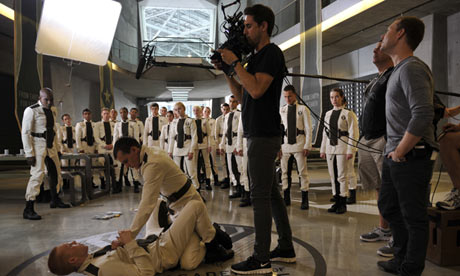
Filming of Halo 4: Forward Unto Dawn, which will air once a week on YouTube.
Given that both are such strong visual mediums, video games and films have endured a surprisingly fractious relationship. Yet it is one that neither seems willing to walk away from – the symbiotic allure at its heart is just too strong. The games industry brings ready-made scenarios, characters and a fanbase to movie producers, while exposure on the big screen feeds back into game sales.
Tempting, yes, but the relationship has been repeatedly tarnished, House of the Dead and Wing Commander being prime examples. Now, however, the very model of how film is made and distributed is being examined anew. In Microsoft's first foray into the market, it has chosen to debut its films based on the Halo games not at the cinema but in the form of a free-to-view online series that begins on Friday.

BFI replaces UKFC: 5 year plan announced

See below for full details (from this Guardian article), or go on to the BFI (British Film Institute) site (or the Wiki, or the Guardian's BFI microsite). Some key points:
  • BFI took on the UK Film Council's responsibilities in April 2011
  • by 2017 they'll be spending £24m a year on film production
  • that includes allocating the production finances which help many British films get made
  • they plan a 'BFiPlayer' for 2013, with 10,000 films to be digitised and made available by 2017
Here's a snippet of what they said about film production plans:
The BFI has also taken over responsibility for providing money for film production – The King's Speech, for example, benefited from £1m of lottery money.
In the five-year plan the money given out for production and development will rise annually to £24m by 2017 with "new opportunities for film-makers working in documentary and animation".
There is always lively debate about where money should be given, with David Cameron reported as saying it should be films that have wide commercial appeal.
The BFI's film fund head, Ben Roberts, said tough decisions had to be made. About 20 films a year will be funded, but another 300 will be turned down. But he said: "I don't believe commercial appeal and critical appeal can't co-exist. We can't underestimate how much audiences respond to strong, original film-making."
"The criteria for everybody is that we support film-makers with strong, original, inventive ideas," said Roberts. "It is up to us to have instincts about what we think is going to strike a chord with its audience."
He promised that the "doors are open to all kinds of film-makers" and that the process would be "very open and transparent".
.....

BFI to launch online player with 10,000 films from its archives

Player scheduled for end of 2013 with experts and public helping to choose which films will be digitised over next five years
Still from the The Cumberland Story by Humphrey Jennings
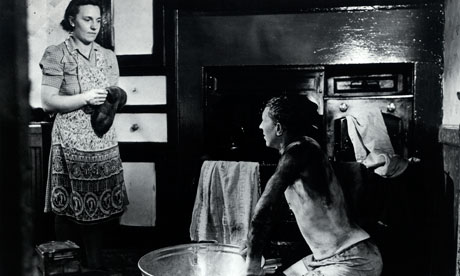
The Cumberland Story by Humphrey Jennings (1945): the BFI's creative director says the online player will give the public access to films that have 'changed our understanding of our film culture'. Photograph: BFI
An internet "player", which will give unprecedented access to Britain's film heritage online, whether that's the innovations of the early pioneer RW Paul or the Mass Observation documentaries of Humphrey Jennings, was announced on Tuesday as part of a five-year plan for British film.
The British Film Institute, which has taken on a lead role for all aspects of film since the abolition of the UK Film Council outlined how it plans to spend over £500m over the next five years.

Tuesday, September 25, 2012

Film directors/studios turn to TV?

We've already seen many big name film directors produce and/or direct work for the small screen, not least Steven Spielberg and, recently, Martin Scorsese (with the excellent HBO series Boardwalk Empire). Now its the Coen brothers' turn, with an unexpected TV series of their early hit movie Fargo. Studio MGM has announced its intentions to use its back catalogue of films to spin off several new TV series over the coming years - see the article below for further details.

Coen brothers developing Fargo TV series

Joel and Ethan Coen to bring Oscar-winning film to the small screen, continuing the story of police chief Marge Gunderson
Frances McDormand in Fargo
Cohen crime caper … Frances McDormand as Marge Gunderson in Fargo. Photograph: Ronald Grant Archive
The Coen brothers are to bring their Oscar-winning film Fargo to the small screen, Deadline reports.
  1. Fargo
  2. Production year: 1996
  3. Country: USA
  4. Cert (UK): 18
  5. Runtime: 97 mins
  6. Directors: Ethan Coen, Joel Coen
  7. Cast: Frances MacDormand, Frances McDormand, Peter Stormare, Steve Buscemi, William H Macy, William H. Macy
  8. More on this film
Joel and Ethan Coen will oversee the TV series, which will be in the one-hour episode format, as executive producers. Fargo, which was released in 1996, marked an early foray for the siblings into Academy award-winning territory: the Coens won best original screenplay and Frances McDormand was named best actress for her role as pregnant police chief Marge Gunderson. The film was also nominated in a further five categories.
The Fargo TV show is part of studio MGM's plan to adapt properties it owns for the small screen through MGM Television. A previous attempt to produce a Fargo show took place in 2003, with The Sopranos' Edie Falco starring as Gunderson. It never got beyond a Kathy Bates-directed pilot, and did not have the blessing of the Coens.
In the Coens' original crime caper the taciturn Gunderson is charged with investigating a homicide after a local car dealer with money problems (William H Macy) hires two hapless goons (Steve Buscemi and Peter Stormare) to kidnap his wife as part of a ransom scam. The film is set mostly in North Dakota, which is populated largely by the descendants of Scandinavian and German settlers.
Gunderson is expected to once again be the main character in the TV series, which will be written and executive produced by Noah Hawley, creator of The Unusuals and My Generation.

Friday, August 24, 2012

Film4 Reimaginings: TisEng wins

Postmodern, comparable in some ways to sweding, an interesting reflection on the limitations of copyright and the importance of UGC for generating revenue for major film companies ... check out this story (with embedded clips): http://www.guardian.co.uk/film/2012/aug/24/this-is-england-film-4


(The key clip won't currently embed: http://www.youtube.com/watch?feature=player_embedded&v=knR2TupbHE4#!)

Wednesday, August 22, 2012

Hollywood encourages piracy?!

This is the claim of a well-argued article at http://www.scientificamerican.com/article.cfm?id=how-hollywood-encouraging-onine-piracy
Good + useful points on the inferior nature of download 'rental' (Netflix etc), all part of the digitisation debate

From a more conventional perspective, here's news of Google bowing to pressure from Hollywood and the music industry to effectively hide search results from certain download sites.

Wednesday, July 25, 2012

Co-Ops + Indie Cinemas in UK

The iPad isn't great for blogging, so at another time I'll develop a links list on this - a topic you need to be able to say something on for your exam, and to be able to claim to truly understand the business of British Cinema and how it interacts with the audience. Whilst the warehouse style and scale multiplexes have now long dominated UK cinemas, there are 1500 Indie cinemas, with 500 supported by the BFFS ('the British Federation of Film Societies (BFFS) which represents more than 500 community cinemas and film societies across the UK'). This article seems to be advertorial (it's not made entirely clear, but looks like it to me), but is useful to get a broader understanding of the diversity of exhibition beyond the multiplexes ... and the role, once more, of digitisation in fostering this change and enabling Indie exhibitors (as digital projection is less skilled and cheaper, and crucially financially supported by a UK Film Council fund - at least until that body was scrapped by the coalition government, a questionable decision on economic or cultural grounds): https://socialenterprise.guardian.co.uk/en/articles/social-enterprise-network/2012/jul/24/co-operative-cinema-opportunity

Tuesday, July 24, 2012

IMAX: The Future or a Con?

As I'm sure many of you did I went to see TDKRises on the NMMs IMAX screen, and enjoyed the visceral experience that the screen size and sound quality offers. 3D has been widely pointed to as the saviour of a cinema business under threat from two results of digitisation: cheap digital home cinema and piracy. Whether the public will continue to pay huge premiums for the questionable benefit of 3D is debatable. We've seen 3D rise before as a fad, back in the 1950s. IMAX nails one of the threats of digitisation though, offering a scale beyond he reach of home cinema.
Director Nolan insisted on shooting over 70mins of TDKRises in IMAX, an incredibly slow, thus expensive, production method, but several recent IMAX releases haven't been shot for IMAX, leading to a similar debate to that raging about digitally rendered 3D conversions of movies shot in 2D. There is even a LIEMAX campaign opposing inferior, potentially misleading IMAX screens.
Have a read through the article below, and some of the comments that follow, to get a grasp of this topic, a very useful case study to show your grasp of industry and consumption trends today. http://www.guardian.co.uk/film/filmblog/2012/jul/23/dark-knight-rises-imax

The Dark Knight Rises, and takes Imax with him
Christopher Nolan is singlehandedly transforming the prospects of the biggest picture show of all
Imax screening of The Dark Knight Rises
Truly immersive? ... an Imax screening of The Dark Knight Rises. Photograph: Julio Cortez/AP
It may be that the awful events at the Century 16 multiplex in Aurora, Colorado, will forever cast a shadow over cinema-going. Yet The Dark Knight Rises could also point the way to a brighter future for an increasingly troubled industry. It could help reshape the way we watch movies.
The film includes 72 minutes of footage shot on the Imax system, the most ever for a studio narrative feature. For director Christopher Nolan, that meant working with cumbersome, jitter-sensitive and noisy cameras capable of only three-minute takes and requiring 20 minutes to reload. Still, he's in no doubt that the extra effort was worth it. He believes he has secured in return "the best quality image that has ever been invented".
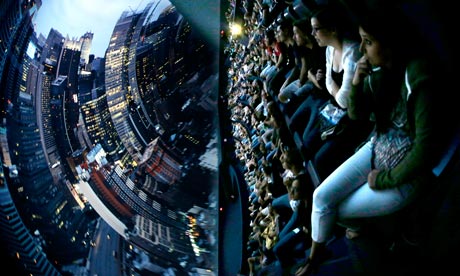
In an Imax ("image maximum") camera or projector, 70mm film runs sideways, taking up 15 sprocket holes per frame instead of 35mm's four. The resulting picture is 10 times larger with 10 times the resolution. Ideally, it's displayed at up to twice the usual brightness, on a curved screen that can be as tall as an eight-storey building. Together with 360-degree surround sound and stadium seating, it's supposed to provide the "most immersive motion picture entertainment" available.

Sunday, July 08, 2012

How Audience became Movie-Makers

How cinema audiences have become movie-makers The film industry used to have all the power over filmgoers. But home video and the internet have changed that relationship http://www.guardian.co.uk/film/2012/jul/05/how-cinema-audiences-became-movie-makers

Monday, May 28, 2012

Cinema-to-DVD release gap to narrow?

I've blogged on this before, back in 2010, but a major studio head has once more raised the prospect of whats currently a 17-week gap between (US) cinema release and DVD release narrowing significantly to combat piracy. Time Warner CEO Jeff Bewkes says the current system simply "create[s] a gap for piracy".
There's another growing trend just now: the widening of the key 'summer' blockbuster season (recognised terminology), with Alice in Wonderland released in March 2011, and Hunger Games in March 2011, a full two months before the traditional May starting point.

Time Warner CEO predicts release date shift to combat piracy

Jeff Bewkes says making films available on all platforms early in their runs will reduce piracy, despite cinemas' objections
ALICE IN WONDERLAND
Tim Burton's 2010 Alice in Wonderland provoked a battle between Disney and UK cinemas over its release window. Photograph: Disney /Sportsphoto Ltd/Allstar
A powerful media mogul who oversees one of the most successful studios in Hollywood, Warner Bros, has predicted the demise of the longstanding "window" between cinema and home video releases in order to combat internet piracy.
Interviewed on the US PBS network's Charlie Rose show, Time Warner CEO Jeff Bewkes said the entire film industry, "including theatre owners" had "an interest" in ensuring that new movies were available early in their runs for consumers to view on any platform, whether at the cinema, on DVD or view-on-demand (VOD). His comments will cause consternation among the owners of cinema chains, who have fought a running battle with studios to retain the traditional 17-week window before new films shift from the big screen to home video.
Bewkes accepted that the issue was a "dangerous" one, and said studios would "be as thoughtful as we can to do it in a way that doesn't undermine the theatre experience". But he nevertheless appeared to indicate that the window's demise was a done deal because the alternative was to "create a gap for piracy". He also predicted that the price of DVDs would come down further in future.
Cinema chains in the UK and abroad fear relaxation of the window in case film lovers decide to save their pennies and see new releases at home rather than travelling to their nearest multiplex. At the moment it is impossible to see new films in high quality anywhere else but the cinema, a monopoly which has arguably helped maintain box office yields since the arrival of VHS in the 1980s.
In 2010 Warner's rival studio Disney fought a battle with UK cinemas over the release window for Tim Burton's blockbuster Alice in Wonderland. In the end the film was released in cinemas according to the usual schedule and went on to gross more than $1bn at the global box office. The total worldwide box office stood at $36.6bn last year, up 3% on 2010, but only because markets such as China and Russia are growing rapidly and 3D films continue to yield a higher premium. Given that experts suggest that piracy costs the US economy alone more than $20bn annually, Bewkes's prediction begins to look more than reasonable. Nevertheless, further battles with cinema chains no doubt await if Hollywood decides to move forward with its current plans.